

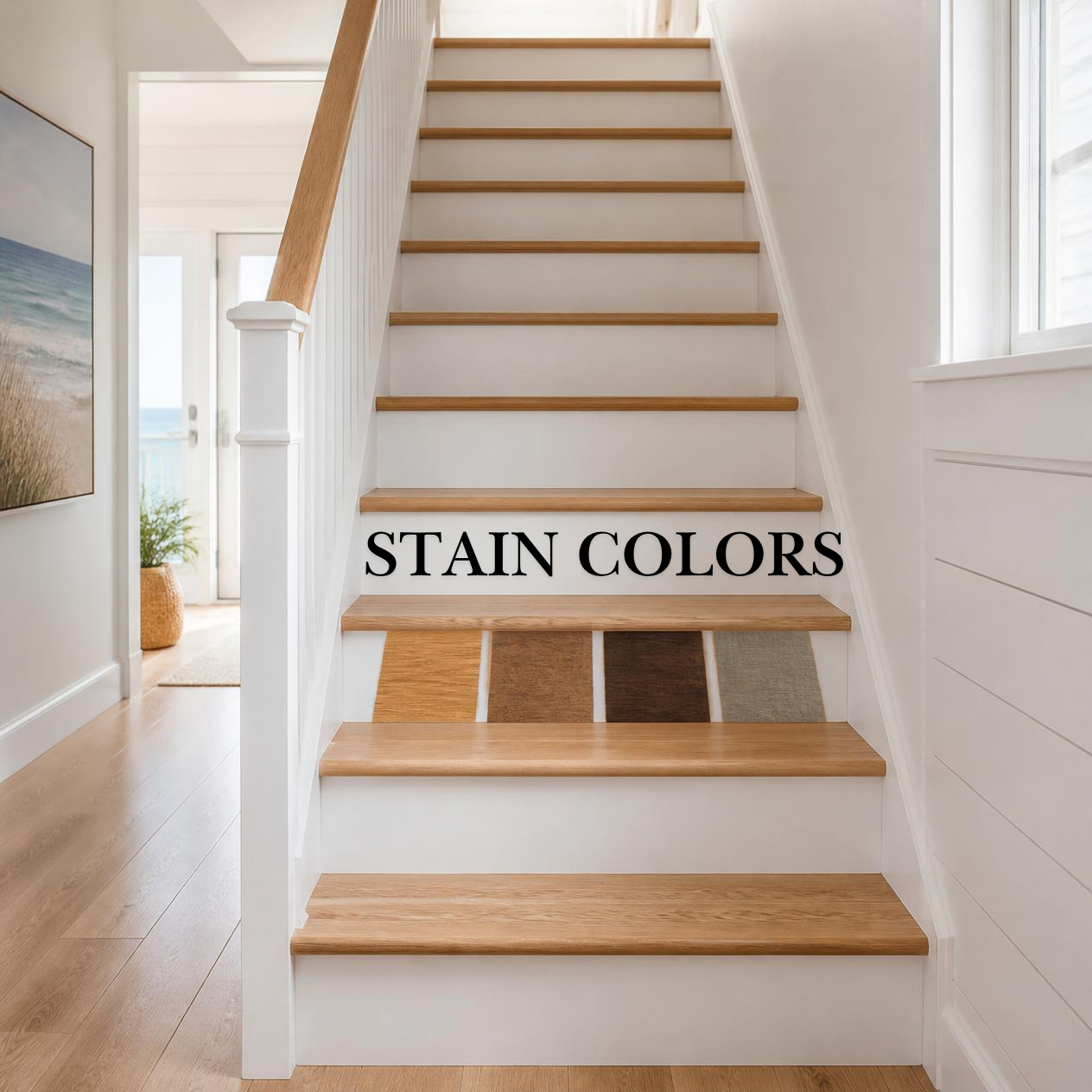
The right stain color for refinished stairs is the one that looks right on your own treads, in your own light, next to your own floor. The only way to know that is to sample it on the stairs before anyone opens a full can. Every stain maker whose systems our crews are certified in says so in capital letters on its data sheets. The rest of this page is about making that sample count.
Your stairs do not have to match the floor. They have to get along with it. Match the undertone first, warm with warm or cool with cool. Then decide whether the stairs should blend in or stand out. An exact match is rarely possible anyway, and the first section explains why.
The safest color for most homes is a medium brown in the walnut family. It hides dust and beach sand better than a dark stain and hides wear better than a pale one. It also sits comfortably beside almost any floor.
Your wood decides how any color reads. Red oak pushes pink through light and gray stains. Maple blotches. Pine takes color in stripes. The chips on a display board were stained on red oak, and your stairs may be something else.
The finish shifts the color again. An oil-based polyurethane adds an amber cast that deepens for years. A waterborne finish dries clear and keeps the color you sampled. A tinted sealer can nudge the tone warmer or cooler with no stain at all.
Here is the short version of the seven color families and how each one behaves on a staircase.
| Color family | How it lives on stairs | Best on |
|---|---|---|
| Natural, no stain | Shows the wood as it is; ambers under oil finish | White oak, maple, clear pine |
| Light and whitewashed | Airy; shows shoe marks; turns pink on red oak | White oak, maple, ash |
| Golden and honey | Warm and traditional; can go orange on red oak | Red oak, pine, hickory |
| Medium brown | Hides dust and wear; suits most floors and trim | Any species |
| Dark walnut, espresso, Jacobean | Dramatic; shows dust, sand and scratches | Red oak, white oak, hickory |
| Gray and greige | Cool and modern; turns rosy on red oak | White oak, maple |
| Black and ebony | Bold with white risers; slowest to dry; shows everything | Oak, maple, ash |
The page runs in this order. First, whether stairs should match the floor. Then the color families one by one, how your wood species changes each color, and separate sections on gray and on dark stains. After that come the finish and sheen, how to test a color properly, which parts of the staircase get stained or painted, and paint versus stain. The last stretch covers stairs beside plank floors, color and safety, runners, cost and timing, outdoor steps, keeping the color even, and a set of common questions. Scroll to your part.
Do stairs have to match the floor?
No, stairs do not have to match the floor, and in most houses they cannot match it closely even when everyone tries. Stairs and floors are usually different pieces of wood, sanded on different days and often from different species. They age and take light differently too. What stairs must do is coordinate. They should share an undertone with the floor and make a clear choice about whether they blend or contrast.
Undertone is the word a refinisher uses before any other. Every wood tone leans one way. Golden oak, honey, cherry and most red oak lean warm, toward yellow, orange and red. Driftwood, greige, ash and many modern white oak floors lean cool, toward gray, taupe and green. Two floors that share an undertone can differ a lot in depth and still belong in the same house. Two floors that fight over undertone look wrong even at the same darkness.
How to decide between matching and contrasting
You are standing at the bottom of the stairs with a chip in your hand, wondering how close a match to the floor you need. Three questions settle it. Are the stairs and the floor the same species? Are they being sanded and finished at the same time? And when you walk in the front door, which one does your eye land on first?
Two yeses mean a true match is possible and usually the calmest choice. The same stain on the same species, sanded to the same grit and topped with the same finish, comes out the same color. That is the one situation where "match the floor" is a plan rather than a hope.
A different species, or a floor that is staying as it is, calls for a cousin rather than a twin. Keep the undertone and pick a color one or two steps darker or lighter than the floor, so the difference reads as a decision. A stair color that is almost the floor color but slightly off looks like a mistake from across the room. A stair color that is clearly a shade darker looks planned.
Take the most common case at the Shore. The floors are 1990s golden red oak and they are staying. The stairs get a warm medium brown one or two steps darker than the floor, the risers are painted white, and the handrail matches the treads. The warm undertone ties the stairs to the floor, the extra depth makes the difference look intentional, and the white risers keep the whole thing from reading as one slab of oak.
When the staircase is the first thing you see from the door, give it a stronger color than the floor and treat it as the feature it is. When the stairs sit in a side hallway, quieter is better. A dramatic staircase you only glimpse in passing has nowhere to make its point. And when the floor is laminate or luxury vinyl plank, matching is off the table from the start, because a printed plank and a real oak tread are different materials. Coordinating the undertone is the whole job, and a later section works through it.
Dark stairs with light floors
Dark stairs on a light floor work when the two share an undertone and the risers are painted white. The white breaks up the mass of dark wood and ties the staircase back to the trim. A dark walnut or espresso tread over a natural white oak floor is one of the most photographed pairings in home design for that reason. The treads read as furniture and the light floor as background.
The reverse, light stairs on a dark floor, is harder to pull off. The eye expects the staircase to be at least as substantial as the floor. It can work in a beach house where the floors are a dark reclaimed look and the stairs are whitewashed as part of a light trim scheme. As a stained-wood combination it usually looks unfinished, as if the stairs were still waiting for their coat.
A handrail in a tone between the two is the useful bridge in either direction. With a light floor and dark treads, a medium-brown rail keeps the staircase from reading as a black cutout. With medium treads and a dark floor, a rail matched to the floor pulls the whole stair into the room.
When the stairs meet two different floors
Your upstairs hall has a different floor from your downstairs, and the staircase touches both. Stain the stairs to the floor you see them against most, which in nearly every house is the downstairs floor. That is where the staircase is part of a room rather than a way out of a hallway. The top step and the landing are where the change happens, and a landing can be stained with the stairs while the hall keeps its own color.
When the two floors are far apart in tone, say a warm oak downstairs and a gray plank upstairs, pick a stair color that shares the downstairs undertone and sits between the two in depth. It will not match either floor. It will look like the piece that joins them, which is what a staircase is.
What color stairs go with gray floors
Gray floors take stairs in three directions. The first is a matching cool gray, which works on white oak or maple treads. The second is a greige, a gray with brown in it, which softens the whole scheme and behaves on red oak. The third is a deliberate contrast in a deep brown-black such as an ebony or Jacobean tone. What gray floors do not take is a golden or honey stair. The yellow-orange undertone fights the gray and both end up looking dingy.
If you want a true match
Getting stairs to match an existing floor is a color-matching job, not a can-of-stain job. The crew sands a sample tread, mixes a custom blend, tests it under the same finish the floor has, and adjusts. Bona publishes dozens of blend formulas for its stains in ratios like "3 parts Jacobean, 1 part Provincial", and every maker our crews work with says its colors can be intermixed.
A refinisher who does this often will get you close. Expect close rather than identical, because your floor has years of light on it and your new stairs have none. The section on keeping the color even explains how much a floor moves over time.
Stair stain colors, family by family
Stair stain colors sort into seven families, and the family matters more than the name on the can. The same name is a different color from one maker to the next. Bona, LOBA and WOCA all sell a "Walnut", a "Grey" and a "White", and none of the three matches the others. The notes in each family name two or three colors from the charts our crews are certified in, so you can point at something real in the showroom.
Bona's own chart carries a second warning worth reading twice: "Samples shown are on red oak. Color swatches are for visual representation only and can vary based on computer display settings, species of wood and type of finish applied." Your species and your finish are the two things a chart cannot show you, and each has its own section on this page.
Natural, with no stain
A natural staircase skips the stain and lets the finish show the wood as it is. It is the right call when you like the wood you have. White oak comes up a soft tan, maple a creamy blond, clear pine a pale honey. Under an oil-based finish "natural" is not colorless, because the finish is amber and the wood darkens with light. Under a waterborne finish the wood stays close to its sanded color.
This is also the family where a sealer does the work. Bona describes its NaturalSeal as creating "a very close look and depth of pure, freshly sanded wood" with a small amount of white pigment. On the stain charts, Bona's Natural and LOBA's Neutral are untinted bases used mostly to dilute stronger colors.
Light and whitewashed
Light and whitewashed stairs make a small hall feel bigger and suit coastal rooms. They are also the hardest family to keep looking clean, because every shoe mark and grain of dark grit shows on a pale tread. And they depend on species more than any other family. White pigment on white oak reads as driftwood. White pigment on red oak reads as pink, because the wood's own color comes through a thin stain.
Bona's data sheet says its White, Grey and Birch tints "are most suited for use on lighter 'blonde' floors". Colors in this family include Bona's White and Sand Dune, LOBA's Country White and WOCA's White oil. A white-pigmented sealer with no stain is the other route to a pale staircase, and the gray section explains it.
Golden and honey, and the orange oak problem
Golden and honey stains are the traditional choice and the one most often being refinished away. On red oak under an aged oil-based finish they turn the orange people mean when they say "1990s oak". The color was never the problem by itself. Red oak has a pink-red heartwood, the golden stain adds yellow, and the oil finish adds amber on top for twenty years. Yellow plus red plus amber is orange.
If you like warm stairs and have red oak, choose a golden tone with some brown in it rather than a pure gold, and finish it with a waterborne product that will not amber. The result stays honey instead of drifting to orange. On white oak, hickory or pine, golden stains read as intended. Bona's Golden Oak and Early American, LOBA's Gunstock and WOCA's Antique oil are all in this family.
Medium brown, the safe choice for most homes
A medium brown is the best stain for stairs in most houses, for practical reasons rather than fashionable ones. It is dark enough to hide the fine scratches, dust and tracked-in sand that show on a light tread. It is light enough that pet hair and dust do not sit on it the way they sit on espresso. It leans neither warm nor cool enough to fight most floors or trim, so it survives a kitchen renovation and a change of wall color.
Medium browns are also where red oak and white oak stop disagreeing. Once there is enough brown pigment in the stain, red oak's pink and white oak's green-tan are both covered, and the two species come out nearly the same. That makes a medium brown the right pick when the stairs are one species and the floor is another. Bona's Special Walnut and Provincial, LOBA's Medium Brown and English Chestnut, and WOCA's Walnut oil sit here.
Dark walnut, espresso and Jacobean
Dark stains give a staircase the most presence and demand the most from both the crew and the household. On the crew's side, an even dark color usually needs water-popping, which means wetting the sanded wood so the grain stands up and takes more stain, and the darkest colors dry far more slowly than a medium brown. On the household's side, dark treads show dust, dog hair, sand and every fine scratch. At the Shore, the sand wins.
Bona's Jacobean and Antique Brown, LOBA's Dark Walnut and Heritage Brown, and WOCA's Brazil Brown oil are the dark browns on the charts our crews are certified in. Paired with white risers, any of them reads as designed rather than gloomy. The dark section covers the prep and the upkeep.
Gray and greige
Gray stains are modern, cool and unforgiving of species. On white oak or maple a gray stain reads as gray. On red oak it reads as lavender or rose, because the thin gray pigment lets the wood's pink through. Greige, a gray with brown in it, is the fix for most houses. It keeps the cool, modern feel and has enough brown to cover the pink. Bona's Grey and Driftwood, LOBA's Classic Grey and Weathered Oak, and WOCA's Castle Grey oil are the ones to sample.
Black and ebony
Black and ebony stairs are the boldest choice and, with white risers and a white or black handrail, one of the cleanest. They are also the least forgiving. An ebony tread shows every speck, and any sanding scratch left in the wood shows through as a lighter line. The darkest stains are also the slowest to dry. Ask for water-popping and a matte or satin finish, and keep a brush by the door. Bona's Ebony, LOBA's Ebony and WOCA's Black oil are the colors here.
How your wood species changes the stain color
Wood species changes stain color more than any other single factor, because a stain is mostly transparent and the wood's own color shows through it. The USDA Forest Products Laboratory's Wood Handbook puts the mechanism plainly: "Stains accentuate wood grain by absorbing differently into EW, LW, knots, vessels, and flaws." Earlywood and latewood are the soft and dense bands in every growth ring, and they drink stain at different rates. The same can gives different results on oak, maple and pine.
Most stairs in Monmouth and Ocean County homes are red oak, which the American Hardwood Information Center calls "the most widely used species". Newer homes and renovations often have white oak, maple or hickory. Older Shore houses that were built to have carpeted or painted stairs may have pine or fir under the carpet, and that changes the whole color conversation. A refinisher can tell the species from the grain and the sanded color in a minute. The table gives you the clues.
| Species | Sanded bare, it looks | What to expect from stain |
|---|---|---|
| Red oak | Pinkish-red brown, coarse open grain | Takes all colors; light and gray tints show pink |
| White oak | Light-to-dark brown, tighter figure | Takes gray and light tints well; tannin can shift color |
| Hard maple | Creamy white, fine close grain | Blotches without a wash coat; good clear or painted |
| Hickory | White sapwood, reddish-brown heartwood | Two-tone stays visible under any stain |
| Pine, fir | Pale yellow with hard dark grain lines | Stains in stripes; dents; often better painted |
| Poplar | Creamy to greenish, plain grain | Paint-grade; stain looks flat |
Red oak
Red oak takes every stain color and looks good in most of them, with one condition. The lighter and cooler the stain, the more of its pink you will see. The American Hardwood Information Center describes red oak heartwood as "a pinkish-reddish brown" and says it can be stained to a golden finish with a wide range of tones. That range is the species' strength. Its weakness is that white, gray and pale driftwood stains sit on top of the pink rather than covering it.
Red oak also has an open, coarse grain that soaks up stain, so a color can land one shade darker than the chart. On a staircase that is a feature, because the grain reads clearly from the bottom of the stairs. If you want red oak to look cool or gray, plan on a greige, a dark brown-black or a white-pigmented sealer instead of a straight gray stain.
White oak
White oak is the species that gray, whitewashed and natural looks were designed on, and it takes them better than red oak. Its heartwood is "light-to-dark brown" rather than pink, in the American Hardwood Information Center's words, and its grain carries more of the light flecks that show as figure under a clear finish. It also carries more tannin. LOBA's stain instructions warn that "Woods with high tannin content (example: White Oak) can affect the color", which is one more reason to sample.
White oak is slightly harder than red oak, 1,370 against 1,290 on the Wood Handbook's side-hardness scale, which matters a little for wear at the front edge of each tread. If your floors are white oak and your stairs are red oak, the medium browns are where the two meet.
Maple and birch
Maple and birch blotch when stained, so a maple staircase either stays natural, gets a wash coat before the stain, or gets painted. The American Hardwood Information Center says it plainly: "Tight grain wood, such as hard and soft maple, and cherry, will often become blotchy when stain is applied." The same body describes hard maple as creamy white with a fine, close texture and says it suits enamel finishes and brown tones, which is a polite way of saying paint or a mid-brown.
The wash coat is a thinned sealer applied before the stain. The Wood Handbook explains that these coats "work by partially filling the void spaces in wood, impeding stain absorption". That evens the color and also limits how dark it can go. Maple is very hard, 1,450 on the Handbook's scale against 1,290 for red oak, so a natural maple staircase under a durable clear finish is a long-lived choice.
Pine, fir and other softwoods
Pine and fir treads take stain in stripes and dent easily, which is why so many older staircases were painted or carpeted in the first place. The Wood Handbook notes "the strong density difference and thick latewood bands in southern yellow pine and Douglas-fir". Stain follows that difference. The soft earlywood goes dark, the hard latewood stays light, and the grain turns to stripes. Eastern white pine measures 380 and Douglas-fir 710 on the Handbook's hardness scale, against 1,290 for red oak.
Softwood stairs can still be stained. A wash coat tames the stripes, mid-brown colors hide them best, and a matte finish keeps the dents from catching light. If the treads are badly worn or patched, painting them is often the better use of the money. So is capping them with new oak treads and staining those, which a refinisher can price against paint after a look.
Hickory, walnut, mahogany and poplar
Hickory keeps its two-tone look under any stain, walnut needs little or none, mahogany reddens on its own, and poplar wants paint. The American Hardwood Information Center describes hickory as white sapwood "tinged with brown, while the heartwood is pale to reddish brown", and no stain erases that contrast. A medium brown softens it and a dark stain hides most of it. Hickory is the hardest common stair wood at 1,970 on the Handbook's scale, so it takes traffic well.
Walnut is already the color most people are trying to stain oak toward, so a clear or lightly tinted finish is usually right. Mahogany, common on the porches and older staircases of Shore homes, darkens toward red with age and light. A natural finish or a brown with no red in it keeps it from going too far. Yellow poplar, a common riser and trim wood at 540 on the hardness scale, looks flat under stain and belongs in the paint group.
Gray stain on stairs
Your floors or walls have gone cool and you want gray stairs. Gray stain works on white oak, maple and ash, and it backfires on red oak, where it comes out rosy or lavender. The reason is simple. A gray stain is thin pigment over wood that is naturally pink. Before you order anything, find out what your treads are. If they are red oak, you have three honest options: a greige with enough brown to cover the pink, a white-pigmented sealer with no stain, or a very dark brown-black that reads cool without being gray.
Why gray turns pink on red oak, and what to use instead
Gray stain has almost no brown or yellow in it, so it cannot cover a warm wood. When a cool gray sits over red oak's pink-red heartwood, the eye mixes the two into a dusty rose or a faint purple. Bona's data sheet adds a second caution. Color change from light "may be more evident where DriFast White, Grey and Birch have been used", so a gray that looked right on day one can drift on a sunny staircase.
Greige solves most of this. A gray with a brown base has enough warmth to sit on red oak without turning pink, and it still reads as a cool neutral next to gray walls and floors. Bona's Driftwood and Aged Pewter, LOBA's Weathered Oak and WOCA's Castle Grey oil are all in this territory. Sample the greige and the straight gray side by side on your own tread, under the finish you will use, and the difference is obvious in daylight.
Two more things belong in the gray conversation. Ask for a waterborne finish over any gray, because an oil-based finish adds amber and pulls gray back toward brown. And know that some refinishers bleach red oak with a two-part wood bleach to knock the pink down before a cool color. It is a harsh step, and Bona positions its whitewash sealer as the route to a light, cool look "without adding stain or caustic bleach".
The white-sealer route to a light, cool staircase
A white-pigmented sealer is how many pale, cool staircases are made without gray stain at all. Bona describes its NordicSeal as giving a "Scandinavian, white-washed look without adding stain or caustic bleach", with twice the white pigment of its NaturalSeal, and successive coats build from a light wash to a full whitewash. On white oak the result is driftwood. On red oak it is a soft pink-beige that many people like once they see it against white risers. It is not gray, though, and you should see it on your own wood before deciding.
Dark stained stairs
Dark stained stairs look wonderful in photographs and take more work to live with, and both things are true at once. A dark tread hides nothing. Dust, dog hair, sand from the beach and every fine scratch show against it, especially in the raking side light of a stairwell window. Choose dark if you love it and are willing to sweep. Pair it with white risers, and ask for a satin or matte finish, which the National Wood Flooring Association notes is less likely to reveal scratches and normal wear than a gloss.
The white risers do two jobs on a dark staircase. They make the run of dark treads read as design rather than gloom, and they mark the edge of every step for the eye, which matters on the way down and matters most for anyone whose eyesight is not what it was. The safety section explains the research behind that.
Dust, sand and scratches
Beach sand is pale, and pale grit shows on a dark surface the way dark grit shows on a pale one. Our guide to floor colors that hide sand in Jersey Shore homes makes the point for floors, and stairs are worse. Sand collects in the corner where the tread meets the riser, and the stairwell light rakes across it. A medium brown hides it. An espresso does not. If your household comes home from the beach through the house, weigh that before choosing the darkest color on the chart.
Water-popping and the longer dry times
An even dark color on a staircase usually starts with water-popping. The crew wets the freshly sanded wood so the grain stands up and holds more stain. Bona's data sheet says the process "lifts the grain and brings a slightly rough but even surface which 'holds' more stain, thus giving a darker colour", and it warns that missed or uneven areas show as lighter patches once the stain goes on. The wood then has to dry, for 12 hours in Bona's instructions, before staining. On a staircase that is a full extra day.
The darkest colors also dry slowly. Bona's sell sheet gives 2 hours for its wood tones under normal conditions but "12-18 hours for Ebony, Spice Brown, Bark and Cocoa". It adds that humidity and temperature outside its 35 to 75 percent and 60 to 80 F range extend dry times. On a July job at the Shore, a dark stain can push the schedule by a day.
How the finish changes the color
The clear finish that goes over the stain changes the color, and the change is not small. The National Wood Flooring Association describes oil-based finishes as "amber in color" and water-based finishes as normally clear. A gray stain under an oil-based polyurethane comes out greige. A natural white oak under the same finish comes out honey. That is why a sample is only a sample once the finish is on it.
This section sticks to what the finish does to color. Our comparison of oil-based and water-based finishes for hardwood floors covers durability, odor and cost.
Oil-based polyurethane ambers
An oil-based polyurethane adds a warm amber tone the day it goes on and keeps deepening for years. On a golden or medium brown stain that warmth is often the point. It is the "old oak" look. On a gray, a white or a natural pale wood it is the enemy, because it pulls every cool color back toward yellow. If you chose a cool or light stain, an oil-based finish will undo part of your choice within a couple of years.
Waterborne finishes stay clear
A waterborne finish dries clear, so the stained color you approved on the sample is the color you live with. That is why most gray, white, greige and natural staircases are finished with one. Bona's data sheet for its waterborne Traffic HD says the finish is "Clear and colorless when dry." The same sheet recommends a third coat in heavy-traffic areas, and few surfaces in a house see more traffic than a staircase.
Tinted sealers shift the tone without stain
A tinted sealer is the middle option between no stain and stain. It is how a refinisher gets "a little warmer" or "a little cooler" without changing the color family. Bona's line runs from NordicSeal, a whitewash, through NaturalSeal and the clear ClassicSeal to AmberSeal, which Bona says gives a "Warm, rich, oil-modified undertone, but won't get yellower or darker with age."
AmberSeal under a waterborne finish is how you get the warmth of oil without the drift. On a stained staircase the sealer goes over the stain and shifts it slightly. On a natural one, the sealer is the color.
Colored penetrating oils are color and finish in one
A colored penetrating oil is the third route, and it changes both the look and the schedule. WOCA describes its Master Color Oil as a "Penetrating oil with color and oil in 1 product", in ten colors from White through Antique, Walnut and Brazil Brown to Castle Grey and Black. Bona's Craft Oil 2K works the same way in six blendable colors. The oil soaks into the wood instead of forming a film on top. The look is low-sheen and matte, with the grain open to the touch, and worn spots can be re-oiled without sanding the whole staircase.
The trade-off is time and care. WOCA says its oil can be used "with caution after 12 hours and is fully hardened after 7 days", and its instructions keep water and cleaning away for those seven days. Bona's Craft Oil 2K allows light use after 8 to 12 hours and is fully cured after 5 days.
An oiled staircase also needs periodic re-oiling in the tread centers where shoes wear it away. For a household that wants a natural, matte, repairable surface and can live with a week of care, it is a lovely finish. For a rental turnover in three days, it is not.
Sheen deepens color and shows wear
Sheen is the last thing that changes how a stain color looks, and on stairs it also decides how much wear you see. The National Wood Flooring Association lists gloss, semi-gloss, satin and matte in descending order of shine, and lower sheens are less likely to reveal scratches. The Wood Handbook adds the other half: "gloss accentuates imperfections such as planer marks, hammer marks, raised grain, and joints in the wood."
A gloss finish makes a dark stain look deeper for about a month, then shows every footprint. Satin is the usual answer for stairs, and our guide to hardwood floor sheens for coastal New Jersey homes explains why matte and satin suit Shore houses.
How to test a stain color on your stairs
Test a stain color by having it applied to your own sanded tread, under the finish you will use, and by looking at it in morning light, evening light and lamp light before anyone stains the rest. Every maker says so. Bona's data sheets put it in capitals: "ALWAYS PREPARE A SAMPLE OR TEST AREA TO DETERMINE COMPATIBILITY, APPEARANCE AND DESIRED RESULTS." LOBA's instructions carry the same line. A chip in a store, a photo on a phone and a can label are not samples.
Sample on your own treads
The sample has to be on your wood, sanded the way the job will be sanded, because both change the color. Bona's data sheet notes that "Sanding more finely will reduce penetration of the stain, reduce the colour intensity", so a tread cut to a finer grit comes out lighter than one cut coarser. Ask the crew to put two or three colors side by side on one tread near the bottom, where you see the stairs from the room, and to top each with the finish.
On our jobs, staining is the fourth of six steps, after inspection, preparation and sanding and before finishing, and our hardwood and stair refinishing page describes it as applying "a new stain color of your choice". The sample is where that choice gets made. Approve it in writing, on the tread, before the crew moves on.
Look at the samples in three kinds of light
Light changes color, and stairwells have some of the strangest light in a house. There is usually a window at the landing, a dark run beneath it and lamps at night. Bulbs are labeled for this. The Federal Trade Commission's Lighting Facts label states a bulb's "Light Appearance" in kelvin on a scale from 2,600 K to 6,600 K. ENERGY STAR's guide describes 2700K as a soft white like a warm sunset, 3000K to 4100K as neutral to cool white, and 5000K as daylight, "think blue sky at noon".
The practical version is this. A gray stain under a 2700K bulb at night looks brown. A golden stain under a 5000K bulb looks flat and yellow. Whatever bulbs are in the stairwell now are the bulbs to judge the samples under, and if you plan to change them, change them first.
At the Shore, daytime light is bright and often bounced off water and sand, which lifts every color and pulls the pink out of red oak. Gray winter days do the opposite. Look at the samples on two different days if you can, once in the morning and once with the stairwell lights on. Look down the stairs from the top as well as up from the bottom. A tread seen from the top is mostly its flat face. A tread seen from the bottom is mostly its nosing, the rounded front edge, and the shadow under it.
Why a second coat will not fix the wrong color
If the sample is not right, change the color, not the number of coats. Bona's data sheet is blunt about this: "Making additional applications of stain makes minimal difference to the final colour achieved so it is important that the correct colour is chosen prior to commencement". A wood stain penetrates until the wood is full and then stops. The tools that change depth are the sanding grit, water-popping and a blend of two colors, and all three have to be decided before the first tread is stained.
Treads, risers, handrail, balusters and newel
A staircase is five different parts, and the most common finishing scheme stains the horizontal ones and paints the vertical ones. Treads and handrail are stained. Risers, balusters and the stringers, the sloped boards that carry the treads, are painted, usually white. The newel post goes either way. The scheme is popular because it solves the two problems a staircase has. Painted risers are cheap to keep looking fresh, and a handrail that matches the treads ties the top of the stair to the bottom.
| Part | Usual treatment | Why |
|---|---|---|
| Treads | Stained to your color, satin finish | Take the wear; carry the color |
| Risers | Painted white or trim color, semi-gloss | Kicked by toes; paint touches up easily |
| Handrail | Stained to match treads, or painted black | Hands darken it; ties the stair together |
| Balusters | Painted white, or iron | Hard to stain evenly; white reads light |
| Newel post | Stained with the rail or painted with balusters | The anchor; either works |
| Stringers and skirt | Painted with the trim | Read as baseboard |
Stained treads with white risers
Stained treads with white risers is the classic American staircase, and it suits every stain family from natural to ebony because the white belongs to the trim, not to the treads. The riser is the vertical board your toe kicks. Painting it means scuffs are a touch-up, not a refinish. The Wood Handbook notes that for interior woodwork "high-gloss or semi-gloss enamels are more common than flat paints", and a semi-gloss riser also wipes clean. If your trim is not white, paint the risers to match the trim and the effect is the same.
Why white risers yellow, and the primer that stops it
White risers turn yellow or show brown bleed-through for one reason. The wood's own extractives and the old finish come through the paint. The Wood Handbook says that over knots or finger-jointed lumber "a stain-blocking primer is often used to minimize discoloration", and a previously stained riser being painted white for the first time needs the same primer. Skip it and the brown ghost of the old stain shows within a season.
Handrail and banister stain colors
Match the handrail to the treads, not to the floor. The rail and the treads are what the eye reads as "the staircase", and a rail that matches a floor two shades away from the treads splits the stair into pieces. The reason to restain the rail in the same job is that years of hands have darkened and worn it unevenly, so it needs sanding anyway. Handrails are almost always oak or maple, and a maple rail on an oak stair will not take the tread color the same way, so expect the crew to adjust the blend.
The other classic is a black rail, painted or ebony-stained, over white balusters. It works with any tread color because black and white are neutral to everything. If the treads are painted rather than stained, a stained rail in the floor's tone is the one exception to the match-the-treads rule, because then the rail is the only wood on show.
Balusters, spindles and newel posts
Balusters are usually painted white. Staining thirty turned spindles evenly is slow and expensive and rarely looks as clean as paint, and white spindles let a dark tread and rail do the talking. Iron balusters in black or bronze are the other common answer and pair with every stain family.
The newel post can go either way. Stained with the rail, it makes a strong anchor. Painted with the balusters, it lets the rail float. In a hallway with white trim, painting it is the quieter choice. At the foot of a feature staircase, staining it is the bolder one.
Paint or stain for stairs?
Stain on the treads and paint on the risers is the right answer in most houses, and the reason is wear. A stained tread under a hard clear finish hides scuffs in its grain and can be refreshed with a maintenance coat. A painted tread is a film of color that shoes scrape through.
The Wood Handbook explains that film finishes "often get worn away by repeated cleaning or by abrasion" and that thicker, harder films are needed for high-wear surfaces such as floors. Paint is thinner and softer than a floor finish, so it shows the traffic path first.
When stain wins
Stain wins whenever the treads are a hardwood in decent shape. It keeps the wood visible, hides small dents and scratches in the grain, and can be recoated without stripping. It also makes a staircase look like part of a hardwood house rather than a painted afterthought. If the treads are oak, maple or hickory and you were considering paint only to hide their color, a darker stain will do that with less upkeep.
When paint is the right call
Paint is the right call when the treads are softwood, patched, mismatched or damaged beyond what sanding can fix, and when the look you want is a painted cottage stair. Pine and fir take stain in stripes and dent easily, and poplar looks flat under stain. A floor and porch enamel, which the Wood Handbook notes is formulated to resist abrasion on porch floors, holds up better than a wall paint on a tread.
Painted treads wear along the walking line first, a foot-wide path up the middle, and they can be slick when the paint is new and glossy. Keep the sheen at satin or semi-gloss, expect to touch up the centers every few years, and consider a runner up the middle. The runner covers the wear path and adds grip, and the runner section explains how to pair one with a stained or painted stair.
Matching stairs to prefinished hardwood, laminate or vinyl plank
Stairs next to a factory-finished floor are matched by undertone and depth, not by chasing the plank's exact color. A printed or factory-stained plank and a site-stained oak tread are different materials that will never be identical. Decide whether the stairs should read as a cousin of the floor or as a deliberate contrast, then sample against a spare plank on the actual tread. The three kinds of floor differ a little.
Next to prefinished hardwood
A prefinished hardwood floor was stained and finished in a factory, usually with a topcoat a site finish cannot copy, so even the same species will not match perfectly. The floor maker's own stair nose, the molding that caps the front edge of a step, and its matching tread pieces are the way to a true match. If you are refinishing existing stairs instead, aim one shade off the floor in the same undertone, and use a satin waterborne finish so the sheen and color sit close to the factory look.
Next to laminate or luxury vinyl plank
Laminate and luxury vinyl plank are printed images of wood, so real oak treads will never match them closely, and trying makes both look worse. Take the plank's undertone and stain the stairs to a real-wood cousin of it. Most gray-brown planks are cool, so a greige or a mid-brown works. Most oak-look planks are warm, so a honey or medium brown works.
A plank with a "wheat" or "field oak" name is usually a warm, light tan, and a medium brown stair with a touch of gray sits well beside it. Our guide to matching new laminate to existing hardwood works through undertone, grain and transitions from the other direction.
Overlay tread kits
Overlay tread kits, sold at home centers under names such as Cap A Tread, are caps that go over an existing tread and riser. Their colors are named after the maker's laminate and vinyl plank designs rather than after stains. They exist to make a stair match a plank floor without refinishing, and they are chosen by holding the plank against the kit.
If your treads are solid hardwood, sanding and staining them is usually the better long-term answer. If they are damaged softwood under a plank floor, a kit or new oak treads are both reasonable, and a refinisher can tell you which after a look.
Stain color and stair safety
Stain color affects stair safety in one specific way. The edge of each tread has to be visible, and a uniform dark run of stairs in a dim stairwell hides the edges. A 2014 study in Experimental Gerontology by researchers at the University of Bradford found that "stairs with high-contrast edge highlighters positioned flush with the tread edge will improve safety on stairs, particularly for those with age-related visual impairment". It opens with the reason this matters. Falls while descending stairs are, in the study's words, "the leading cause of accidental death in older adults."
Contrast at the tread edge
White risers under stained treads are the simplest way to mark every step edge. The light riser outlines the dark nosing whether you are looking up the stairs or down them. A staircase stained one dark color from tread to riser to stringer loses that outline, and so does a pale staircase in a white hall.
If someone in the house has trouble seeing steps, keep the tread and riser in strong contrast, or plan a runner with a border that marks each nosing. The same study found falls "three times more likely to occur during stair descent compared to stair ascent", so the view from the top matters most.
Light, switches and handrails
Color reads only as well as the light allows. The CDC's home fall-prevention checklist asks, "Is there a light and light switch at the top and bottom of the stairs?" and tells homeowners to have an electrician put both in if not. The National Institute on Aging says the same and adds handrails "on both sides of any stairs". A refinishing job is the moment to do this work, because the stairs are already out of use and the stringers are exposed.
Grip comes from runners and treads, not the finish
A satin or matte finish hides wear and glare better than a gloss, but grip on a stair comes from a runner or from non-slip treads, not from the sheen of the finish. The CDC checklist says to "Make sure the carpet is firmly attached to every step, or remove the carpet and attach non-slip rubber treads to the stairs", and the National Institute on Aging suggests no-slip strips on tile and wooden floors. A fitted runner does both jobs and lets you keep the stained margins on show.
Stair runners and carpet on stained stairs
A stair runner and a stained stair are partners, not rivals. The runner takes the traffic up the middle, and the stained margins on either side show the wood. Choose the stain first, then the runner, because the wood is permanent and the runner is not. We make custom runners and area rugs from any carpet we carry, cut to your stair width and length. Our runner page notes that custom runner rugs "especially in hallways or stairs, can reduce the risk of slips and falls."
Choosing a stain to sit under a runner
With a runner planned, the exposed margins are what you see of the stain, so choose a color that reads well as a frame. A medium or dark brown makes a patterned runner look grounded. A pale natural margin makes a dark runner look like it is floating. The margins also wear less than the center of a bare tread, so a lighter or more delicate stain that would be a chore on an open stair becomes practical under a runner.
Carpet colors that pair with stained wood
A runner on stained stairs should either pick up the wood's undertone or contrast with it cleanly. Warm oak margins take oatmeal, sisal tones, rust, navy and deep green well. Cool gray or greige margins take charcoal, ivory, blue-gray and black-and-white patterns. A striped or bordered runner marks each step edge, which helps the safety point as well as the look. On stairs, a dense loop or a low cut pile wears best where feet turn on the nosing, and our guide to carpet types explains the difference.
What staining stairs costs and how long it takes
Refinishing and staining a staircase is a job of a few days. Nationally it costs several hundred to a little over a thousand dollars for a standard straight run, and the color you choose affects the schedule more than the price. The stairs are out of full use while the stain dries and the finish cures, so the timeline matters as much as the number, especially in a house with one staircase.
National cost ranges
Angi's cost guide, updated in June 2026 from surveys of completed customer projects, puts the average cost to refinish stairs and railings at $788, with a normal range of $321 to $1,255. It says "A 10-step staircase runs $700 to $1,100." Those are national figures, not ours.
What moves the number is the count of steps, whether the railing and balusters are included, repairs to loose or damaged treads, and whether risers and spindles are being painted. A very dark or very light color adds labor, because water-popping and extra drying add hours. Our older post on what hardwood floor refinishing costs walks through the same factors for floors. For a number that is ours, for your own stairs, request an estimate.
How long the stairs are out of use
Plan on the stairs being off limits for at least a day after the last coat and treated gently for several more. Our post on what to expect during stair refinishing says you may be asked to stay off the stairs for 24 to 48 hours. The makers' own numbers explain why, and they differ by product. The table shows the published times for the products our crews are certified in.
| Step | Published time | Source |
|---|---|---|
| Water-popping before a dark stain | Dry 12 hours before staining | Bona stain data sheet |
| Oil-modified stain, wood tones | About 2 hours to dry | Bona sell sheet |
| Oil-modified stain, ebony and darkest browns | 12 to 18 hours to dry | Bona sell sheet |
| LOBA stain, all colors | Finish can go on after 1 hour | LOBA product page |
| Waterborne finish coats | 2 to 3 hours between coats | Bona Traffic HD data sheet |
| Walking on a waterborne finish | After 24 hours; full cure 3 days | Bona Traffic HD data sheet |
| Colored penetrating oil | Careful use after 12 hours; hard in 7 days | WOCA product page |
Put together, a straight staircase with a medium brown stain and a waterborne finish is typically sanded and stained one day, finished the next, and walkable in socks the day after. Rugs and heavy traffic wait for the third day after finishing, because Bona's sheet says the finish is 80 percent cured after one day and fully cured after three. A dark stain with water-popping adds a day at the front. An oiled staircase is usable sooner and fully hard later.
If the stairs are your only route between floors, ask how the crew will stage the work. Finishing every other tread, or one side at a time, is a common answer, and it is worth knowing before the job starts.
Summer humidity at the Shore
Humidity slows everything in that table. Bona's dry times assume 35 to 75 percent relative humidity and 60 to 80 F, and conditions outside that range extend them. The State of New Jersey's climate summary gives an average midday humidity of 68 percent along the seacoast against 57 percent inland, and a muggy August afternoon in Belmar runs well past that. Air conditioning and fans keep a job on schedule. A closed-up summer house without them does not. If your project is a rental turnover in July, tell the crew and build a spare day into the plan.
Exterior steps, porches and decks
Outdoor steps take a different stain from indoor stairs, and the color rules change with it. Exterior stains are penetrating and pigmented and are made to weather. Interior stains are colors meant to live under a clear film. The Wood Handbook recommends penetrating finishes for decks because "Horizontal surfaces exposed to the rain and sun, such as decks, are prone to peeling", and it warns that solid-color stains form films and peel like paint. Porch floor finishes are a third thing, formulated to resist abrasion.
On color, the Handbook observes that "Most people prefer colors that accentuate the natural color of the wood". On a mahogany porch or cedar steps that means a semi-transparent stain in the wood's own family rather than a gray or a solid color. A semi-transparent stain shows grain and needs recoating more often. A solid stain hides grain and peels if it is over-applied. Our deck maintenance service covers cleaning, sealing and staining, and we refinish mahogany porches, so the same conversation about undertone and sample boards applies outside the door.
Keeping the color even for years
A stained staircase changes color slowly with light, and the way to keep it even is to keep the light even. The Wood Handbook says that indoors "dark wood gets lighter and light wood gets darker", driven mainly by visible light rather than direct sun. A runner or rug left in one place on new wood leaves a sharp line, and the Handbook's advice is to check under rugs after a few weeks and move them periodically. On stairs, that means lifting a new runner once in the first months and expecting the margins to shift a shade.
Day to day, treat stained stairs like a stained floor. Sweep the sand out of the tread corners, wipe spills, use a cleaner made for the finish, and keep felt on anything that sits on a landing. Our guide to caring for newly refinished hardwood floors has the full list, including why vinegar and steam are out.
When the tread centers start to dull, a maintenance coat restores the sheen without touching the color. The National Wood Flooring Association describes that as cleaning and lightly sanding the existing finish and applying a fresh coat. Sanding back to bare wood is, in the NWFA's words, "the perfect opportunity to change the color", and the next time you want a new stain, that is the job.
Frequently asked questions about stair stain colors
Should stairs match the upstairs or the downstairs flooring?
Stairs should match, or at least share an undertone with, the downstairs floor, because that is the floor you see the staircase against from the main rooms. The upstairs floor meets the stairs only at the top step and the landing, and a landing can be stained with the stairs while the upstairs hall keeps its own color. If the two floors differ sharply, choose a stair color in the downstairs undertone at a depth between the two.
Can you stain pine stair treads?
Yes, pine stair treads can be stained, but the color comes out striped and the treads dent, so most refinishers suggest a wash coat before a mid-brown stain, or paint. Pine's soft earlywood drinks stain and its hard latewood does not, which is the mechanism the Wood Handbook describes for southern yellow pine and Douglas-fir. Eastern white pine measures 380 on the Handbook's hardness scale against 1,290 for red oak, so a stained pine tread also shows heel dents that oak would shrug off.
Can a handrail be restained without sanding it bare?
Only by going darker. A heavily pigmented stain can sit on a thoroughly scuffed and cleaned old finish, but the result looks painted rather than like clear stained wood. Going lighter, or getting true grain clarity, means stripping or sanding to bare wood. On a refinishing job the rail is sanded with the treads and stained to match, which is why we recommend doing both at once.
What stain color goes with gray walls?
A medium or dark brown stair goes best with gray walls, because the warm brown reads as intentional against the cool wall, and a greige stair that shares the wall's coolness is the other good answer. What fights gray walls is a golden or orange oak tone, which looks dated next to them. If the walls are a warm gray, a walnut-family brown is the safe pick. If they are a cool blue-gray, a greige or a near-black works.
How many coats of stain do stairs need?
One coat of stain, applied and wiped correctly, is the norm, and a second coat changes the color very little. Bona's data sheet says extra applications make minimal difference to the final color. Depth comes from the sanding grit, water-popping and the color blend, not from more coats. The finish is different. Two coats is the minimum for a waterborne finish over stain, and Bona recommends a third in heavy-traffic areas, which stairs are.
What is the most timeless stain color for stairs?
A medium brown in the walnut family is the most timeless stair stain, because it has outlasted the golden oak of one decade and the gray of another and still sits comfortably beside both. It hides wear and sand, works on red oak and white oak alike, and looks right with white risers and with painted or iron balusters. If you want something with more personality that still ages well, natural white oak under a clear waterborne finish is the other safe long-term choice.
Is it cheaper to paint or stain stairs?
Painting stairs is usually cheaper up front and costs more over time. Painted treads wear through along the walking line and need repainting, while a stained tread under a hard finish can be recoated without stripping. Fixr's 2025 guide puts painting a stairway at a national average of $400, and Angi's 2026 guide puts refinishing stairs and railings at an average of $788. The refinishing figure includes sanding, which is most of the labor either way. If the treads are hardwood, that sanding is what makes stain the better value.
How long before we can use the stairs after staining?
Plan on staying off the stairs for a full day after the last finish coat and treating them gently for about three days. That is Bona's published schedule for its waterborne Traffic HD: walkable after 24 hours, 80 percent cured in a day and fully cured in three, with rugs held back until then. A dark stain adds its own drying time before the finish even starts, and a penetrating oil needs a week to harden. The exact schedule for your products comes with the sample approval.
If you are ready to see real samples on your own treads, our crews sand, stain and finish staircases across Monmouth and Ocean Counties from our showroom in Belmar. Look through species and finishes in our hardwood flooring guide, or request an estimate, and the color conversation starts with samples on your own treads.


