


A rug is only as safe for your floor as its backing and the pad under it. The fiber on top almost never hurts a floor. The rubber, latex, foam or cloth on the underside is what stains, sticks, traps moisture or scratches, and it is the part most labels say the least about.
On vinyl plank (LVP) and other vinyl floors, keep rubber and latex backings off the floor unless the maker says in writing that they are non-staining on vinyl. Rubber and latex can yellow vinyl for good, and a yellow rectangle that has already appeared cannot be cleaned off. Felt, felt with an EVA back, and woven rugs with no backing are the safe choices.
On tile, almost any rug is safe and grip is the whole problem. A natural rubber or felt-and-rubber pad holds a rug on glazed tile without leaving anything behind. Skip rug tape and cheap PVC waffle pads, which leave a sticky film on tile and grout.
On hardwood, use a breathable felt or felt-and-rubber pad, and keep every rug off a freshly finished floor until the finish has cured. That is about three days for a waterborne finish and a week to be safe with any finish. Move the rug now and then so the wood around it does not tan while the wood under it stays pale.
Here is the short version to take into a store.
Your floor | Tag words that mean yes | Tag words that mean put it back | Pad to buy |
|---|---|---|---|
Vinyl plank, LVT, sheet vinyl | Non-staining, vinyl-safe, felt, EVA, woven, flatweave | Rubber, latex, coir, TPR or non-slip with no non-staining label | Felt, or felt with an EVA back, labeled non-staining |
Tile and stone | Natural rubber, felt and rubber, non-slip, low profile | Rug tape, adhesive, PVC waffle, corner grippers | Natural rubber, or felt and natural rubber |
Hardwood | Felt, felt and natural rubber, breathable | PVC waffle, solid foam, unpadded jute, rugs before the finish cures | Felt and natural rubber, or felt alone under a heavy rug |
The rest of this page goes in this order, so you know how far to scroll. First the words on a rug's label, then each backing with its verdict. Then vinyl floors, then mats and chair mats on vinyl plank, then tile, then hardwood. After that comes what can be done once a floor is already marked, rug pads, rug materials, custom rugs and runners made from carpet, cleaning, and the questions people ask.
What the words on a rug's label mean
Most rug labels name the pile fiber in big letters and the backing in small ones, if at all. A tag that says 100% wool or polypropylene is describing the top. The line you need is the one about the bottom. When the tag does not say, the edge of the rug will.
Where the latex hides
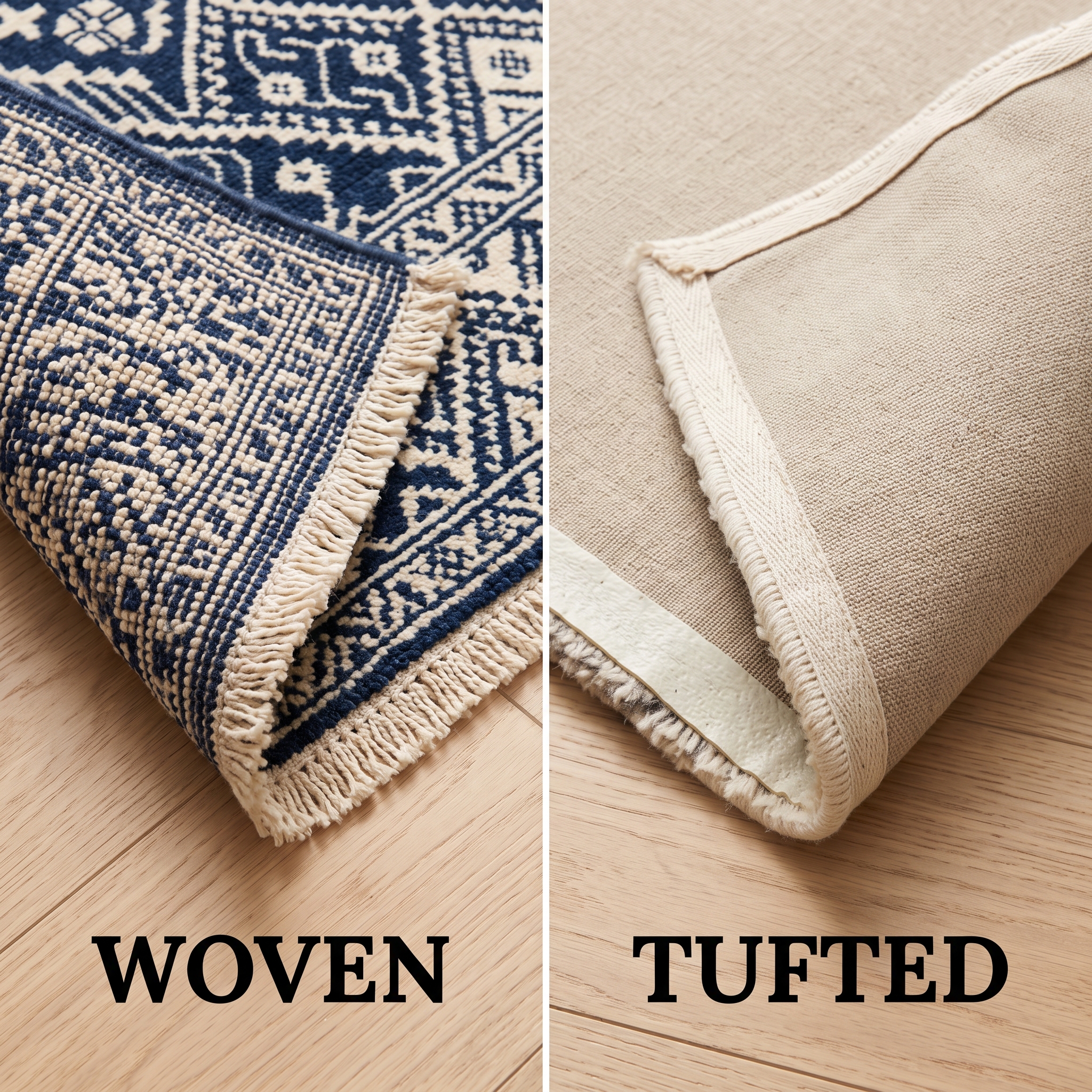
Rugs are built one of two ways. A woven rug has its pile knotted or looped through the foundation, and nothing is glued. A tufted rug has its pile punched into a cloth and held there with a coat of latex, and then a second cloth, called a scrim, is glued over the latex. The Association of Rug Care Specialists, the trade group for professional rug cleaners, says the scrim is added "both to protect the primary backing and for cosmetic reasons."
That scrim is why cotton-backed and jute-backed mean less than they sound. On most tufted rugs, the cotton or jute you see is a skin over latex, and the latex touches your floor wherever the cloth is thin, worn or torn. The same association notes that "from the moment the latex is applied to the rug, it begins to break down," and old latex sheds a fine powder onto the floor under the rug. Warm, humid, sunny rooms make its smell stronger, a familiar complaint in a Shore house that stayed closed up through August.
Two checks tell you which kind you own, and neither needs a label. Turn the rug over and look at the edge. A woven rug shows the same yarns front and back with no separate cloth. A tufted rug shows a stiff canvas with a rubbery layer at any cut edge, and a tuft tugged on the face will pull out, which woven pile never does.
Non-slip is not non-staining
Non-slip describes grip, and non-staining describes chemistry. A rug can have one without the other. Most of the grippy backings on inexpensive kitchen and bath rugs are latex or rubber, the two materials vinyl floor makers tell you to keep off their floors. A backing that grips beautifully can still leave a yellow rectangle behind.
So on vinyl, read past the word non-slip and look for the word non-staining. On tile and hardwood, where staining is not the issue, non-slip is the word you want. Just make sure the grip comes from natural rubber or a felt-and-rubber pad rather than an adhesive coating.
What "vinyl-safe" and "non-staining" really mean
When a rug or pad says vinyl-safe, LVP-safe or non-staining, that is the maker's own promise, and no industry test standard sits behind it. The words are still worth having, because the floor makers use the same language and their wording is what your warranty follows.
Armstrong's care FAQ says rugs and mats are fine on its luxury vinyl "as long as they are labeled 'colorfast' by the manufacturer," and it recommends non-staining, vinyl-backed mats or woven rugs. Colorfast means the rug's own dye will not bleed onto the floor, so Armstrong is asking for both words.
Mannington's care page for its ADURA vinyl says "use non-staining mats on your floor." TRUCOR, the luxury vinyl brand we carry, asks for mats with a non-staining back and says rubber-backed mats are not recommended. When the rug's tag and your floor maker's care guide both say non-staining, the two match and you are covered.
When a rug says only non-slip, or names rubber or latex, or names nothing, treat it as unsafe on vinyl no matter how it is marketed. People ask which company makes the best rug for a vinyl or tile floor. No brand is safe by default. The tag and the care guide decide, and any rug that passes both checks is a good rug.
A test under one corner of the rug catches the fast failures and misses the slow one. Leave the rug and pad down for a few weeks in a spot that gets some sun, then lift them. A tacky pad, a rubbery smell, a haze you can feel with a fingertip or a color that transferred means the pad or backing has to go.
What the test cannot prove is that a rubber or latex backing is safe on vinyl. The yellow stain develops out of sight over months and is permanent by the time it shows. On vinyl the label and the care guide decide, and the corner test is only a second check.
Rug backings one by one
If your rug's tag names one of these backings, its verdict is here, for vinyl and for hardwood and tile. The two kinds of floor fail differently. Vinyl is stained by chemistry, and hardwood and tile are marked by residue, trapped moisture or an imprint on a soft finish. If you already know your floor and your backing is not named, the floor sections that follow answer the rest.
TPR and TPE
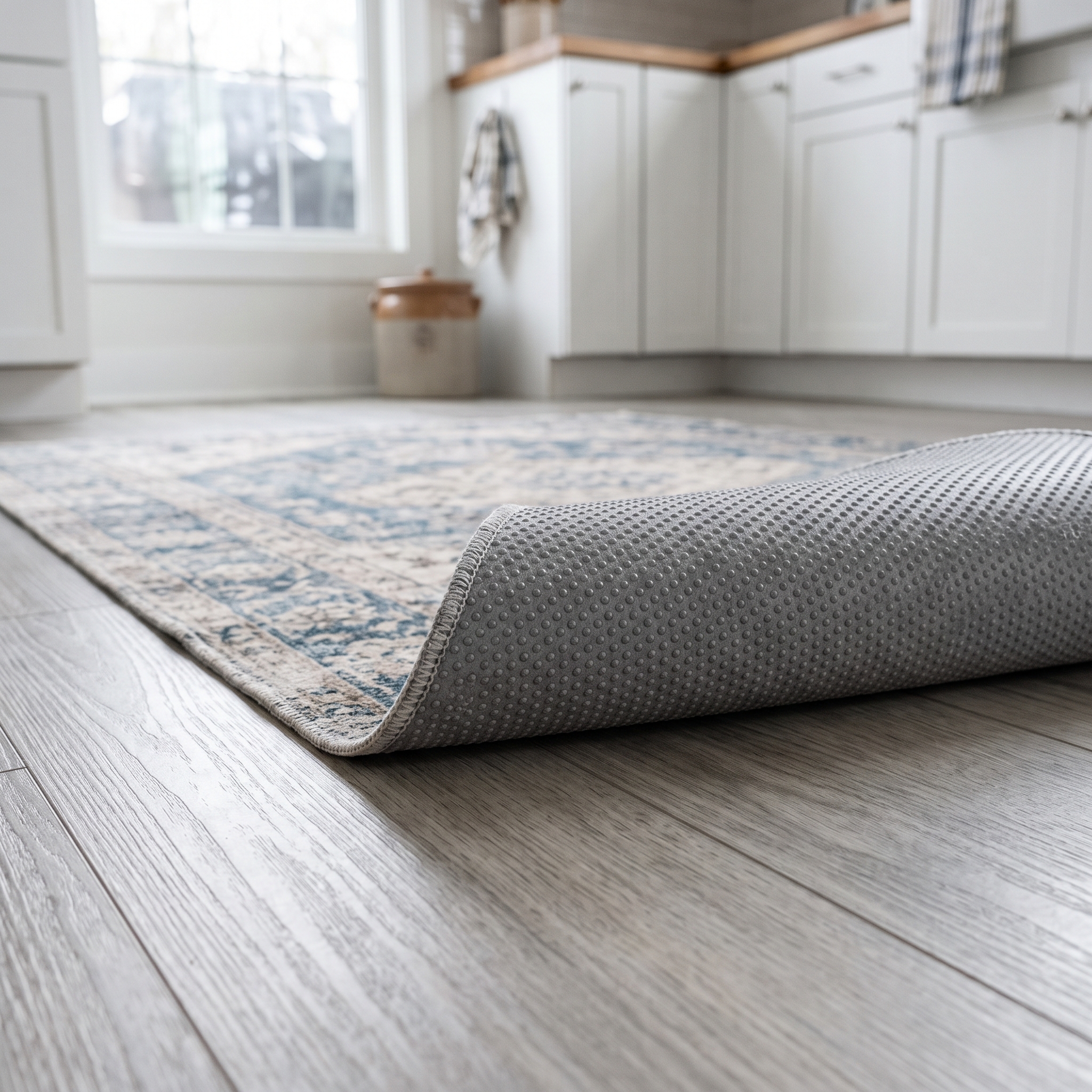
Your new rug's tag says TPR, and you want to know if it is safe on vinyl plank. TPR (thermoplastic rubber) is a plastic that behaves like rubber, and it backs many washable rugs and mid-priced pads. TPE (thermoplastic elastomer) is the wider family it belongs to. Whether a given TPR is safe on vinyl depends on what the maker put in the blend.
No vinyl floor maker we read names TPR either way. Armstrong, Mannington, Shaw, COREtec, AHF Products and TRUCOR all say rubber-backed or latex-backed and non-staining, and nothing more specific. So a TPR-backed rug on vinyl plank is as safe as its maker's statement. Buy it if the tag or the product page says non-staining or vinyl-safe, and pass if it says only non-slip.
If the rug is already in the house, the fallback is a felt pad thick enough that the backing never meets the floor, the same fix that makes a latex-backed rug safe. On hardwood and tile, TPR and TPE are fine as long as the backing is not sticky. Lift the rug now and then so moisture does not sit under it.
Latex and natural rubber
Latex on a rug label usually means SBR, a synthetic rubber spread on the back of a tufted rug or a bath mat. Natural rubber is the tree-sap kind used in the better rug pads. On vinyl plank, both are the backing the floor makers warn about. Shaw's care page asks for "mats without latex or rubber backings to reduce possible discoloration," and Armstrong, Mannington, COREtec and AHF Products, the company behind Bruce floors, say the same in their own words.
Pad makers who sell natural rubber pads often say their natural rubber is non-staining on vinyl, and some people use them for years without trouble. Notice who is speaking. None of the six floor makers we read distinguishes natural rubber from synthetic, and a floor warranty follows the floor maker's care guide, not a pad seller's page. If you want natural rubber on vinyl, buy it only with a written non-staining statement, keep the label, and know that you are relying on the pad maker's word.
On hardwood and tile the verdict flips. Natural rubber is the standard grip layer under a rug on both floors, and a felt-and-natural-rubber pad is the pad most people should buy for hardwood. The cautions there are timing and moisture, not chemistry. Keep any pad off a freshly finished floor until the finish has cured, and lift the rug a couple of times a year so the wood can breathe.
Cotton or jute cloth over latex
A cotton or jute cloth is safe on every floor by itself. The question is what is under it, and on a tufted rug the answer is latex. On vinyl plank, treat a cotton-backed tufted rug the way you would treat a latex-backed one and put a felt pad between the rug and the floor.
On hardwood, a jute scrim is coarse enough to scuff a finish when sand gets under it, and the powder that old latex sheds needs vacuuming up, so the same felt pad earns its place. Under a jute runner in a hallway, use a felt-and-rubber pad with the felt side up against the jute. On tile the cloth is harmless and the rug will slide, so it needs a rubber or felt-and-rubber pad for grip.
Woven rugs with no backing
A hand-knotted wool rug, a flatwoven dhurrie or kilim, a cotton rag rug and a braided rug have no adhesive and no backing layer at all. That makes them the one kind of rug that is chemically safe on every floor on this page.
The trade-off is grip. With nothing on the underside, a flatweave skates on tile and vinyl, so it needs the right pad more than any other rug does. Use felt or EVA-backed felt on vinyl, and natural rubber or felt-and-rubber on tile and hardwood.
PVC, from non-staining vinyl-backed mats to cheap waffle pads
Vinyl-backed is not automatically bad on a vinyl floor. Armstrong recommends "non-staining, vinyl-backed mats or woven rugs," and a quality vinyl-backed entry mat that says non-staining is what that maker wants by the door. The PVC to avoid is a different product.
The trouble comes from the thin, open-mesh waffle pad sold for a few dollars, and from the solid vinyl backing on very cheap bath and kitchen rugs. Those are softened with plasticizers. Over time the softener migrates out, the pad goes tacky and it bonds to whatever it sits on. If a waffle pad has ever come up in pieces when you lifted a rug, that was the plasticizer.
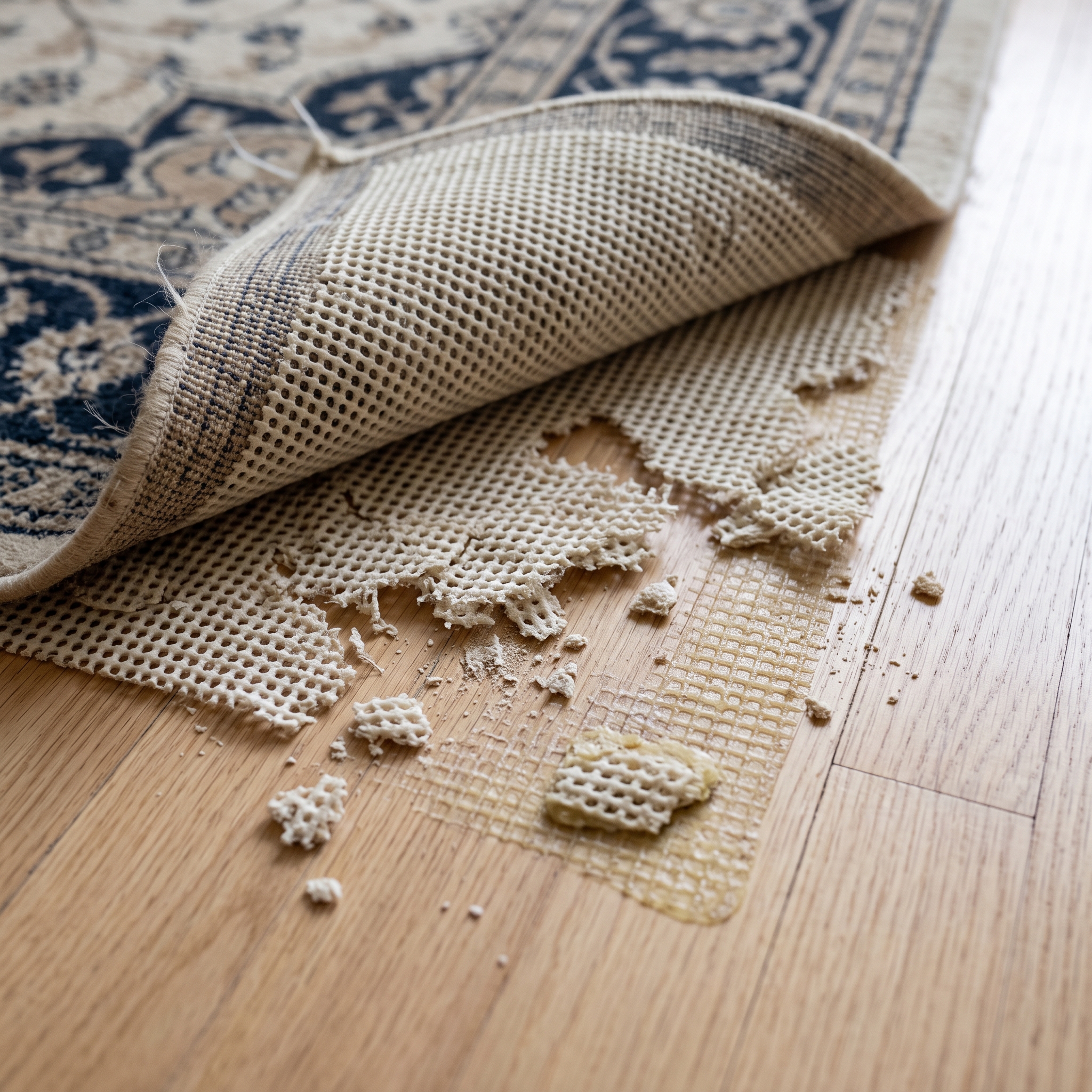
On vinyl plank the migrating plasticizer can leave a dull or sticky patch. On tile and sealed stone the pad glues itself down and leaves a film in the grout. On hardwood it sticks to the finish. The verdict is the same on every floor, so leave the waffle pad on the shelf.
Coir door mats
The bristly coconut-fiber mat at the front door is the one Mannington names alongside rubber and latex. Its care page says "do not put rubber-backed, latex-backed or coco fiber mats on your floor because they will stain or damage the surface." The fiber is abrasive and the mats usually have a PVC or rubber back, so a coir mat belongs outside the door on a vinyl floor. Inside, use a woven mat or a non-staining vinyl-backed mat.
Rug backing | What it is | On vinyl plank | On hardwood and tile |
|---|---|---|---|
TPR, TPE | Rubber-like plastic | Only if labeled non-staining | Fine if not sticky |
Latex (SBR) | Synthetic rubber coat | Avoid; can yellow for good | Fine on cured floors; sheds powder |
Cotton or jute scrim | Cloth glued over latex | Treat as latex; add a felt pad | Add a pad; jute can scuff |
Woven, no backing | Knotted or flatwoven | Safe; needs a pad for grip | Safe; needs a pad for grip |
Non-staining vinyl-backed mat | Quality PVC backing | Recommended by Armstrong | Safe; check yearly for stickiness |
Cheap PVC backing | Plasticized vinyl | Avoid | Avoid; sticks to finish and grout |
Coir mat | Coconut fiber, rubber or PVC back | Outside the door only | Outside the door |
Area rugs for vinyl floors (LVP, LVT and sheet vinyl)
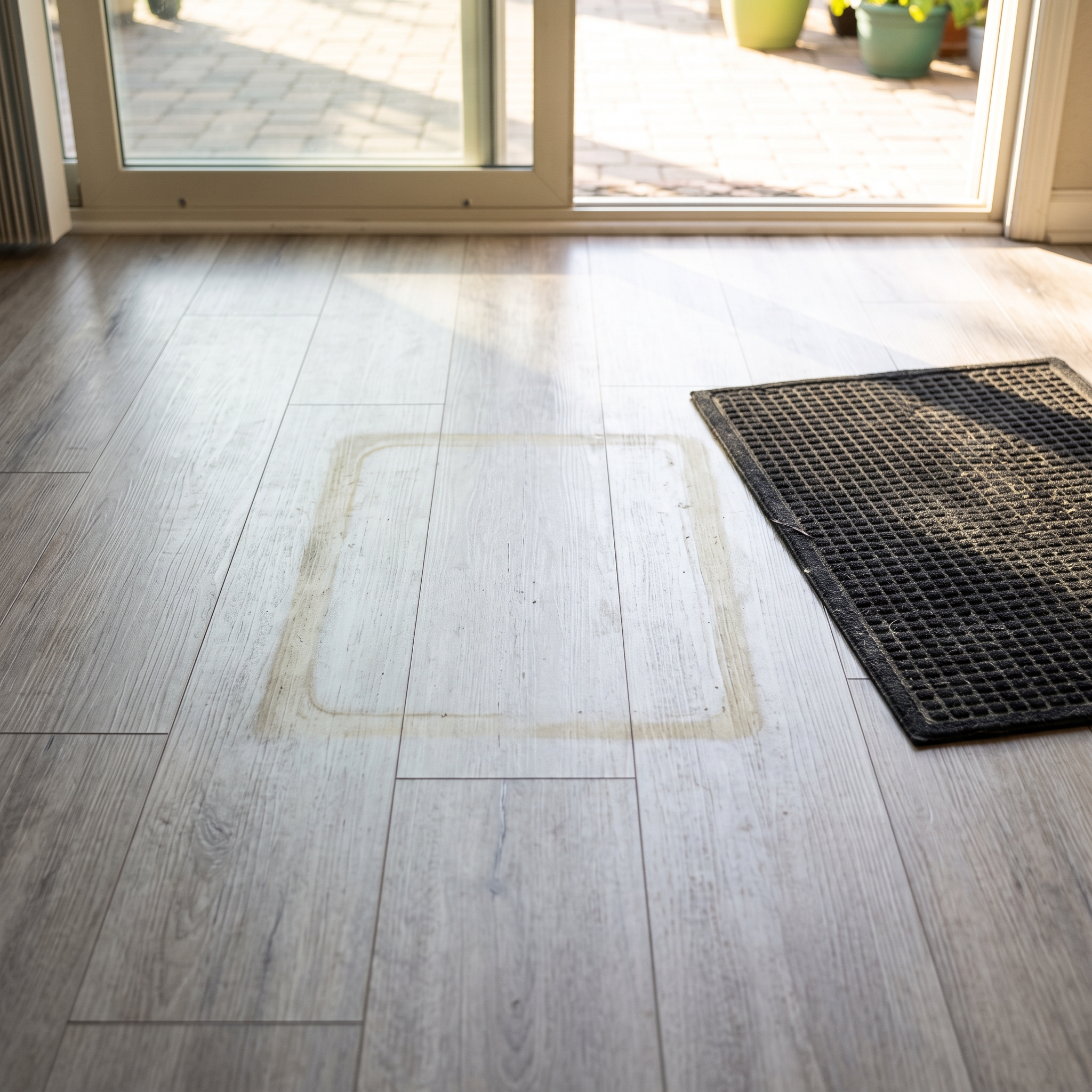
Luxury vinyl plank (LVP), luxury vinyl tile (LVT) and sheet vinyl share one weakness under a rug. The plasticizers that keep vinyl flexible react with the antioxidants in rubber and latex. The result is a yellow or amber stain inside the wear layer, the clear top layer of the plank, and no cleaner removes it. Everything else about rugs on vinyl follows from that.
Why rubber-backed rugs stain vinyl plank
Rubber and latex backings contain antioxidants, chemicals added so the backing does not go brittle. Armstrong explains that it does not recommend rubber- or latex-backed mats "because the chemical (antioxidant) used to keep the backing from becoming brittle can permanently stain your floor." Vinyl's own softeners take part in the reaction. WaterHog, a mat maker with every reason to defend rubber, says some vinyl contains plasticizers that can leach out over time, react with rubber and discolor the floor.
The stain is a change in the vinyl itself, not a deposit on top of it. That is why the same yellowing turns up under rubber stool feet and the wheels of a microwave cart. Mannington adds that heat and sunlight together fade or discolor most furnishings, so a rubber-backed mat by a sunny slider is the worst case. A stain from a mat your floor's care sheet warns against is unlikely to be covered by its warranty.
Which rugs are safe on vinyl plank
Any rug is safe on vinyl plank if the layer touching the floor is felt, EVA-backed felt, a non-staining vinyl backing, or the rug's own woven foundation with no glue. The pile fiber does not matter to the floor. Wool, cotton, polypropylene, polyester, nylon, jute and sisal are all fine on top. Only the underside decides.
If you want examples by construction, these five all pass, and they cover most of what a rug store sells.
A flatwoven cotton dhurrie or wool kilim, on a felt pad.
A hand-knotted or hand-loomed wool rug, which has no adhesive layer, on a felt pad.
A machine-woven polypropylene rug whose underside is the same woven yarn as its face, on an EVA-backed felt pad.
A two-piece washable rug whose maker states that its pad is non-staining on vinyl.
A tufted rug of any fiber, cotton scrim and all, on a felt pad thick enough that the latex never meets the floor.
The nicest rug you can put on LVP is a hand-knotted wool rug. It has no backing to worry about, it hides sand, and it can be washed for decades. Any luxury vinyl floor takes any of these rugs, so the rugs you already own decide only which pad you buy.
Are polypropylene rugs safe on vinyl plank?
Yes, a polypropylene rug is safe on vinyl plank as long as its backing is not rubber or latex, because polypropylene is the fiber on top and never touches the floor. Most inexpensive polypropylene rugs are machine-woven with a woven polypropylene or jute-and-polypropylene underside, which is fine on vinyl with a felt pad. The ones to check are tufted polypropylene rugs, which carry latex under their cloth.
People also ask whether polypropylene rugs are safe in the health sense. The fiber is a stable plastic, and the smell of a new rug usually comes from the latex and adhesives in the backing, not the pile. The Association of Rug Care Specialists says latex "can give off a noxious odor that can vary from barely noticeable to oppressive depending on the quality of the adhesive," and that cleaning will not remove it.
The carpet industry's Green Label Plus program certifies carpet, cushion and adhesives for very low emissions of volatile organic compounds, and the EPA's advice for any product that off-gasses is to increase ventilation while it does. Unroll a new rug in a ventilated room for a few days. If the smell persists, it is the backing.
Are washable rugs like Ruggable safe for LVP?
It depends on the pad, because a two-piece washable rug is a fabric top that sticks to a separate pad, and the pad is what touches your floor. Ruggable's own hardwood guide tells buyers to avoid "plastic or latex backings that can leave marks or residue" and describes its pads as designed for hardwood. We could not open its page on vinyl floors, so check Ruggable's current statement on vinyl and LVP before you order rather than take a blog's word for it, ours included.
The same applies to any other washable system. Find the maker's own line about vinyl and read what the pad is made of. If the answer is a rubber that is not called non-staining, put a felt pad under it or choose another rug. The washable top itself is never the problem, and a washable rug is a sensible choice for a Shore kitchen or mudroom on LVP.
Do you need a rug pad on vinyl plank, and which one?
Yes, you need a pad on vinyl plank, and the one to buy is felt with a thin EVA grip layer, sold as vinyl-safe or LVP-safe. A plain felt pad is the runner-up under a big rug that furniture holds still. Both are free of rubber and latex, both breathe, and both keep a tufted rug's latex off the floor.
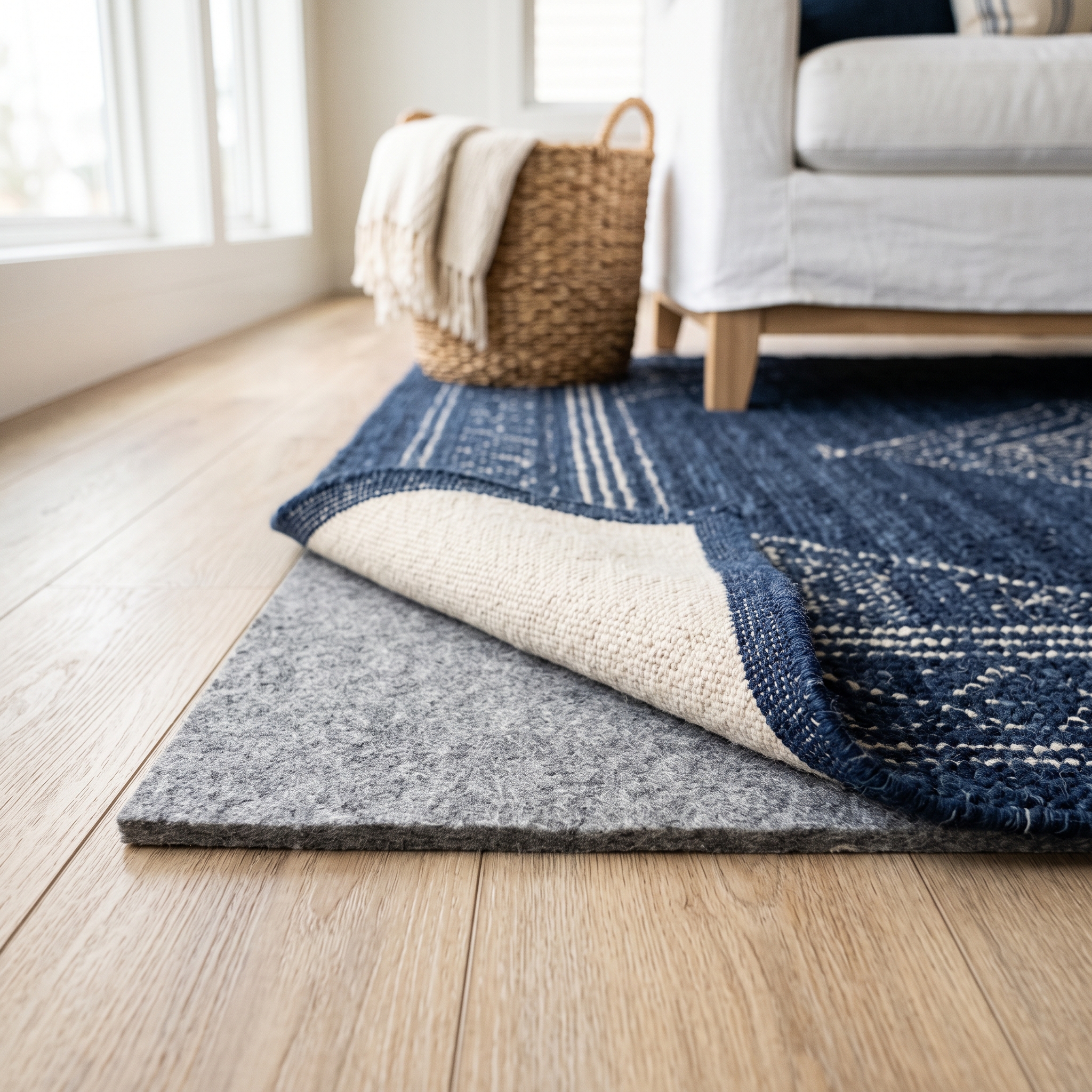
The reasons are different from hardwood, where a pad protects the finish from grit. On vinyl a pad does three other jobs. A woven rug slides on smooth vinyl without one, a tufted rug's latex will eventually reach the floor without one, and a pad is the cheapest insurance against a stain you can buy. Choose 1/8 inch under doors and in kitchens so doors clear and chairs slide, and 1/4 inch in living rooms and bedrooms for cushion.
How to keep a rug from sliding on vinyl without rubber
Most non-slip products are the ones that stain vinyl, so grip has to come from something else. An EVA-backed felt pad is the first answer and solves most runners and small rugs. Furniture is the second, because a rug with the front legs of a sofa or the base of a table on it goes nowhere. Rug tape and adhesive grippers are the last resort, and only if the product states it is safe for vinyl, since a tape that leaves residue on tile leaves it on vinyl too.
Older sheet vinyl and linoleum
Sheet vinyl in an older Shore bungalow or a rental kitchen follows the same rules as plank, and the yellowing under a rubber-backed bath mat or a rubber stool foot is the same antioxidant stain. Armstrong's sheet vinyl answer asks for "non-staining, polypropylene-backed mats or woven rugs." True linoleum, a linseed-oil floor, is different. It yellows where light is blocked and recovers when light returns, so a lighter rectangle under a rug on linoleum usually fades back.
One caution before anyone tears up an old floor because of a stain. Some older sheet vinyl and its felt backing contain asbestos. The EPA says "don't sand or try to level asbestos flooring or its backing," and, when it needs replacing, to install new floor covering over it if possible. Have it tested before it is disturbed, and let a trained professional handle removal.
Mats and chair mats on vinyl plank
Mats cause more vinyl stains than area rugs do. They are small, cheap, rubber-backed by default and placed where heat, water and sunlight are. The same non-staining rule applies to every one of them, from the kitchen sink to the desk chair.
Kitchen and sink mats
The best kitchen mat for vinyl plank is a washable cotton or flatwoven rug on a thin EVA-backed felt pad, or a gel or foam anti-fatigue mat whose maker states it is non-staining for vinyl. The cushioned mats sold for standing at a sink are mostly PVC or rubber underneath, so read the underside before you buy one. Keep the mat small enough to lift and dry after a spill, and lift it weekly for the first month to be sure nothing is transferring.
Entry and door mats
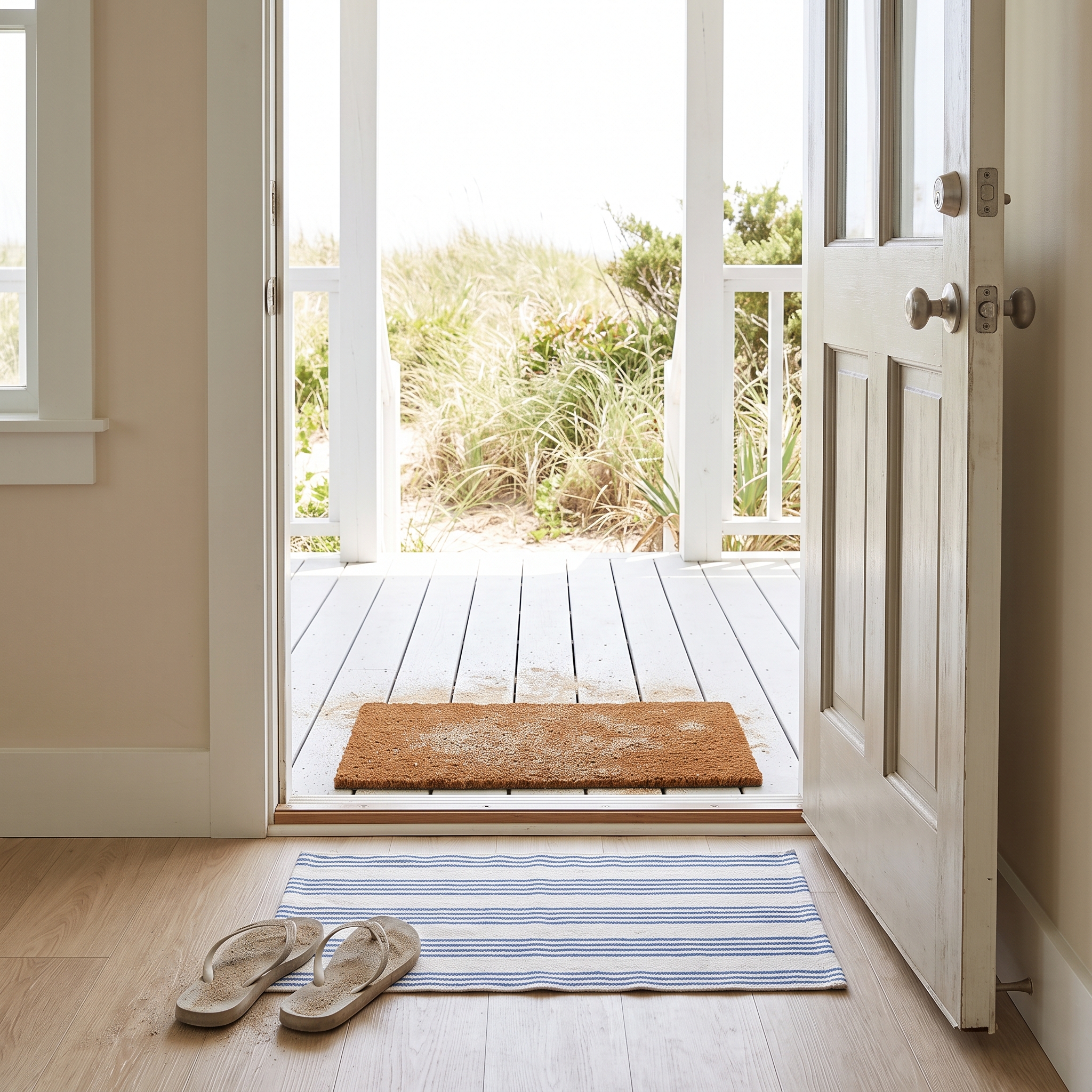
An LVP-safe door mat is a woven mat or a non-staining vinyl-backed mat, which is what Armstrong and TRUCOR both ask for at entrances. The classic coir bristle mat and any rubber-backed muddy-paws mat belong outside the door, not on the vinyl inside it. At the Shore the door mat is also your sand trap, so put a coarse scraper mat outside and a washable one inside, and shake both often. Wash the inside mat weekly in summer and keep it small enough to fit the machine.
Bath mats
A bath mat safe for vinyl plank is a cotton, chenille or microfiber mat with a woven or non-staining back, on a small felt pad if it slides. The rubber-backed bath mat is the most common cause of a yellow rectangle on a vinyl bathroom floor, because it is wet, warm and left in place for months. Hang the mat to dry after showers and it will also last longer.
Office chair mats and casters
The best chair mat for LVP is polycarbonate, a hard, clear plastic with no plasticizer to migrate. Floortex, a chair mat maker, says its polycarbonate mats "will not curl, crack, discolour, dent, smell or buckle under normal use," and it makes its cheaper PVC mats without the phthalate plasticizers that cause the trouble. A vinyl chair mat that does not say non-staining or phthalate-free is a risk on vinyl plank.
The floor makers would rather you fixed the chair. TRUCOR asks for chair mats at desks and for casters at least 2 inches in diameter. Mannington asks for casters with a flat surface at least 3/4 inch wide, and AHF Products does not recommend rolling casters at all. Soft polyurethane casters, the kind sold for hard floors, roll gently enough that many people use them with no mat.
Treadmill mats, exercise mats and furniture pads
A treadmill or exercise mat on vinyl plank should be EVA foam or a mat labeled non-staining for vinyl. The heavy black rubber mats sold for garages are the rubber the floor makers warn about, and a treadmill adds heat. Under furniture, use felt pads or the wide, non-pigmented hard-plastic glides Mannington asks for, at least an inch across and resting flat. Rubber feet on a stool or a plant stand can leave the same yellow ring as a rug backing.
Summer rentals and closed houses
You own a summer rental with vinyl plank downstairs, a house that stands closed for eight months, and tenants who bring their own mats. Put one line in the welcome binder, that bath mats and door mats with a rubber back stay off the floors. Leave a woven bath mat and a non-staining door mat so nobody has to shop. A rubber-backed bath mat left down for a season is the most common way a tenant marks an LVP floor.
When you close the house in September, lift every rug and mat and look for a tacky pad, a rubbery smell or a yellow edge. A rug with a safe backing can stay down all winter on vinyl plank. On hardwood upstairs, either lift the rugs for a day when you close and again when you open, or roll them up for the empty months, which is easier and lets a damp floor dry.
Area rugs for tile floors
Tile takes almost any rug and holds almost none of them still. The rug question on tile is about grip, warmth and grout, and the answers are simpler than on vinyl, because nothing in a rug backing stains glazed tile.
Which rugs are best on tile
The best rugs for tile floors are dense wool or thick-pile rugs on a felt-and-natural-rubber pad, because tile is cold and hard and a rug on tile is there for warmth and cushion first. Wool holds heat, hides sand and springs back under furniture. A 1/4 inch felt layer under it adds real insulation between bare feet and a cold porcelain floor in February. In a kitchen or bath on tile, switch to a washable cotton or flatwoven polypropylene rug that dries fast, on a thin rubber pad.
Color is the other reason people ask about rugs on tile. White and grey porcelain reads cool, so a rug with warm undertones, oatmeal, terracotta, rust or a wool with some cream in it, makes the room feel warmer than the tile does. A cool grey rug on cool grey tile flattens everything. Large-format tile takes a big rug well, and a small rug on big tile looks lost.
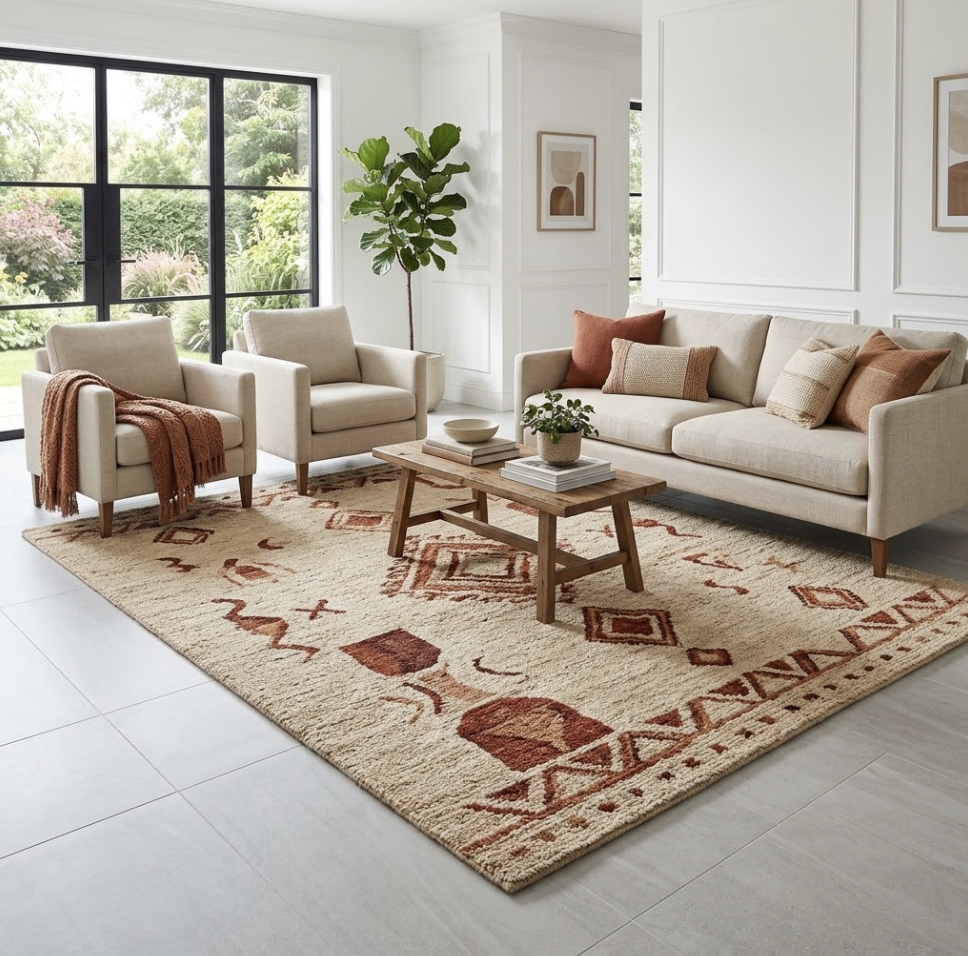
No rug brand is best for tile by default, because the top of the rug hardly matters to tile. What matters is a pad that grips glazed tile without adhesive, a rug heavy or dense enough not to creep, and a fiber that dries if it gets wet. If the size you need does not exist, we make one from carpet, and the custom section of this page explains how.
How to keep a rug from sliding on tile
Your kitchen rug slides on the tile every time someone walks across it. The fix is a natural rubber or felt-and-natural-rubber pad cut about an inch smaller than the rug on each side, and it is the only method that works without leaving anything behind. The Natural Stone Institute's care advice for stone and tile is simply to "be sure that the underside of the mat or rug is a slip resistant surface." Natural rubber is what gives a pad that surface, and it does no harm to glazed tile or grout.
Rug tape and adhesive corner grippers are the methods to skip. RugPadUSA, a pad maker, says to "avoid rug tape on tile, as it will leave a sticky residue that is hard to remove," and that corner-only grippers do not anchor the whole rug. Cheap PVC waffle pads are worse, because their coating breaks down and bonds to the tile and the grout. On a floor with wide or deep grout lines, choose the felt-and-rubber pad, which bridges the joints better than a thin rubber mesh.
Kitchen and bathroom rugs on tile
In a tile kitchen, the runner in front of the sink and stove should be washable and low, on a thin natural rubber pad, so it grips and dries. Spills that sit under a rug on tile soak into unsealed grout, and a wet rug on tile grows mildew fast in a humid Shore summer. In a tile bathroom a cotton bath mat with a rubber back is fine. The staining that rubber causes on vinyl does not happen on glazed tile, and only unsealed natural stone needs the mat lifted to dry.
Rugs over heated floors
A rug on a heated tile floor should be thin and flatwoven, with no thick pad, because any rug insulates the floor beneath it and makes the system work harder. WarmlyYours, a radiant floor heating maker, says items placed on a heated floor "can trap radiant heat and cause the area beneath them to become significantly warmer than surrounding areas."
Nu-Heat, a UK heating maker, caps the combined insulation of carpet plus pad over its systems at about the value of a thin carpet with a thin underlay. A thick wool rug on a memory-foam pad is the combination to avoid.
If the heated floor is luxury vinyl rather than tile, the floor's surface temperature limit is usually 85 F, and a rug that traps heat can push the floor under it past that limit. Our guide to floors that work with radiant heat covers the limits by floor type.
What a tile rug is
If you searched for a tile rug, you may have meant a tile inlay rather than a rug. A tile rug is a patterned panel of tile that reads from across the room like a rug. It is often set into a hardwood floor at an entry or under a dining table, or bordered by plainer tile in a kitchen.
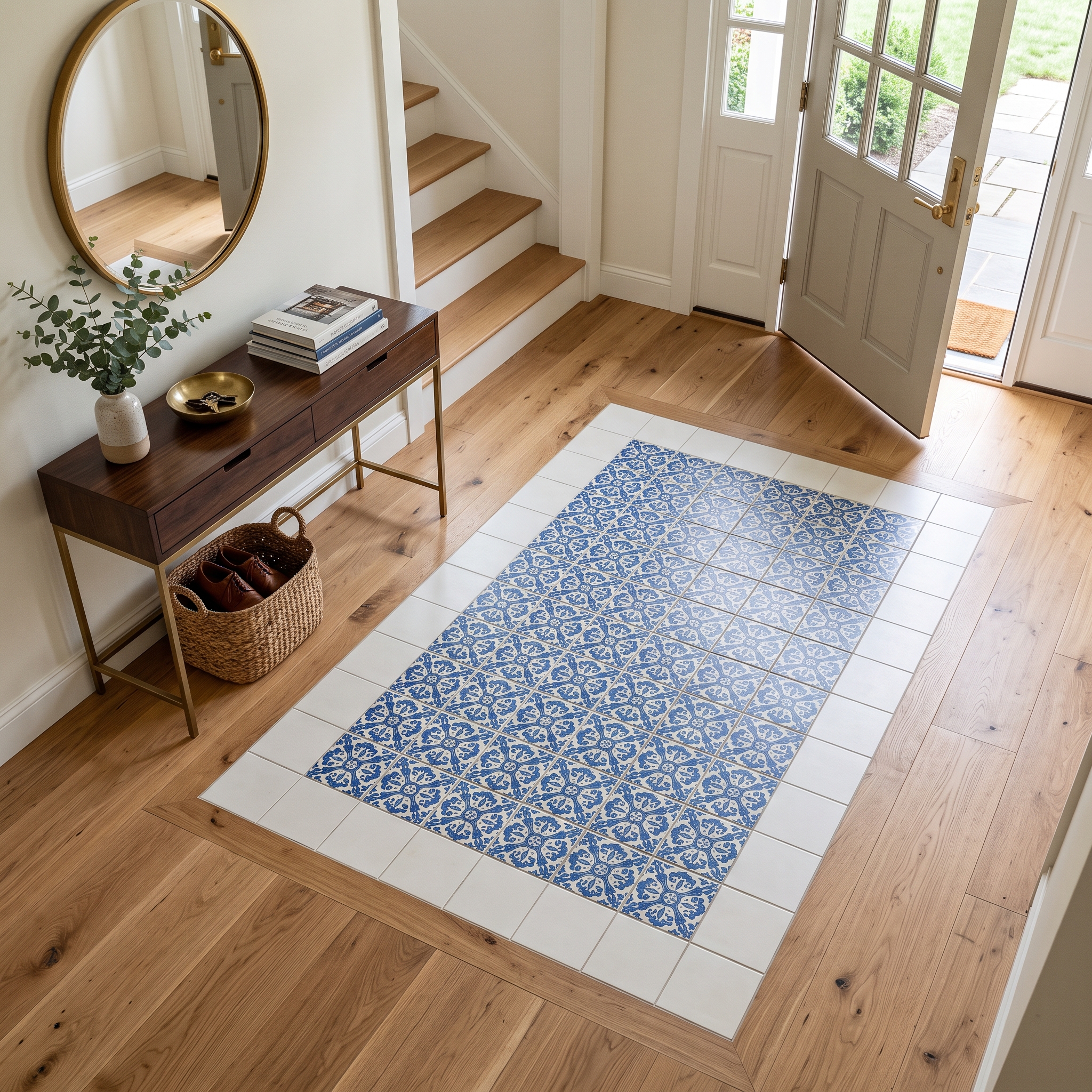
A tile rug never slides, never stains and never needs a pad, but it is a flooring installation, planned before the floor goes in so the tile and the wood finish at the same height. We do not carry tile, so plan a tile rug with your tile installer and keep a real rug for the rooms where you want softness underfoot.
Area rugs for hardwood floors
Hardwood is the floor people worry about most and the one a rug damages least often. The risks on wood are timing, moisture and light rather than chemistry. A rug on a cured hardwood floor with a breathable pad under it protects the wood more than it threatens it.
Which rugs look and work best on hardwood
The best rugs for hardwood floors are wool and wool blends on a felt-and-natural-rubber pad. Wool is resilient, hides soil and sand, and needs no chemical backing, and the pad gives it grip without putting anything on the finish that can mark it. Flatweaves and hand-knotted rugs are the safest constructions on wood. Tufted rugs with a jute scrim are fine with a felt layer between the scrim and the finish.
Polypropylene and polyester rugs work well in kids' rooms and beach entries. Washable two-piece rugs are fine on hardwood as long as the pad has no adhesive, and an indoor-outdoor polypropylene rug is fine if its underside is woven rather than rubber-coated.
What looks right is mostly tone and pile. On pale white oak and maple, a rug with some depth of color, indigo, olive, rust or a dark border, anchors the room. On dark walnut or a dark-stained oak, a light rug with a low pile keeps the floor from swallowing it. Keep pile low where chair legs live and let it get plush where feet do.
Layering works on hardwood better than on any other floor. A large flatwoven jute or sisal base with a smaller wool rug on top gives the room texture, and the jute base gets its own felt pad so it does not scuff the finish. If you are choosing the floor at the same time as the rug, our guide to hardwood flooring and the species and finishes in our hardwood catalog show which woods change color fastest in the sun.

Rug backings that damage hardwood
On hardwood, the backings that cause trouble are the ones that cannot breathe or that stick. That means PVC waffle pads, solid rubber or foam mats, and a waterproof kitchen mat with a solid vinyl or rubber underside. A non-breathable layer traps the moisture a humid Shore summer puts into a house, and a floor that cannot dry under a mat clouds, dulls and in the worst case cups. Our article on rug pads that protect Shore floors without trapping moisture explains why breathability matters more here than inland.
Cheap PVC pads add a second problem. Their softener migrates into a polyurethane finish, and what starts as a sticky film on top of the finish becomes a haze in the finish itself if the pad stays down.
Rubber and latex, the problem backings on vinyl, do no chemical harm to a cured wood finish, which is why natural rubber is the standard grip layer in hardwood pads. A jute scrim is not a chemical risk either, but with beach sand under it, it works like fine sandpaper on the finish, and a felt layer under any jute-backed rug is the fix.
So do rugs ruin hardwood floors? No, but a cheap pad or a wet mat can.
Do you need a rug pad on hardwood, and which one?
Yes, every rug on hardwood needs a pad, and the pad most people should buy is felt with a natural rubber underside. The felt cushions and breathes, and the rubber keeps the rug from creeping and grinding grit into the finish. Under a large, heavy rug that furniture anchors, a thick felt pad alone is fine and softer. Under a runner or a small rug, the rubber matters more than the felt.
We sell a rubber-backed rug pad for hardwood with our rug cleaning service, and it is the right pad for a cured, finished floor. It is not for a floor that was refinished last week, and no pad is for a rug you never lift. Twice a year, and after any humid stretch, roll the rug back for a day so the wood can breathe.
How soon after refinishing can the rugs go back?
It depends on the finish, and the number is on its data sheet, so ask whoever finished the floor which product they used. Bona's data sheet for Traffic HD, the professional waterborne finish our crews use most, says the finish "may be walked on after 24 hours but remains susceptible to scuffing or marring until completely cured." Full cure takes about three days, and the sheet says not to replace area rugs until then.
DuraSeal's data sheet for its oil-modified polyurethane says to "allow product to dry 48 hours before replacing furniture and rugs," and warns that humidity, cold and still air stretch that time. WOCA, whose oil finishes our crews are also certified in, says to wait until the finish is fully cured and recommends a wool rug pad on its oiled floors. It also keeps water off the floor for five to seven days.
The reason is the same for all of them. A rug and pad block air to the finish, and a finish that cures under a rug cures unevenly and can take an imprint of the pad's pattern. In a humid July at the Shore, add a day or two to whatever the label says. If you are unsure, a week is a safe rule for any finish, and our crews, certified by the National Wood Flooring Association, Bona and WOCA, leave you the cure schedule for the finish they used.
Sun, shade and the rug tan line
The rug tan line is the lighter rectangle you find under a rug on a wood floor, and it is the wood around the rug changing color in the light, not the rug damaging the floor. Every species shifts with light, and some shift fast. Frank Miller Lumber, a hardwood producer, uses cherry as the example. Lift a rug a year after a cherry floor goes in, it says, and "the exposed part of the floor is a darker color than the section protected by the rug."
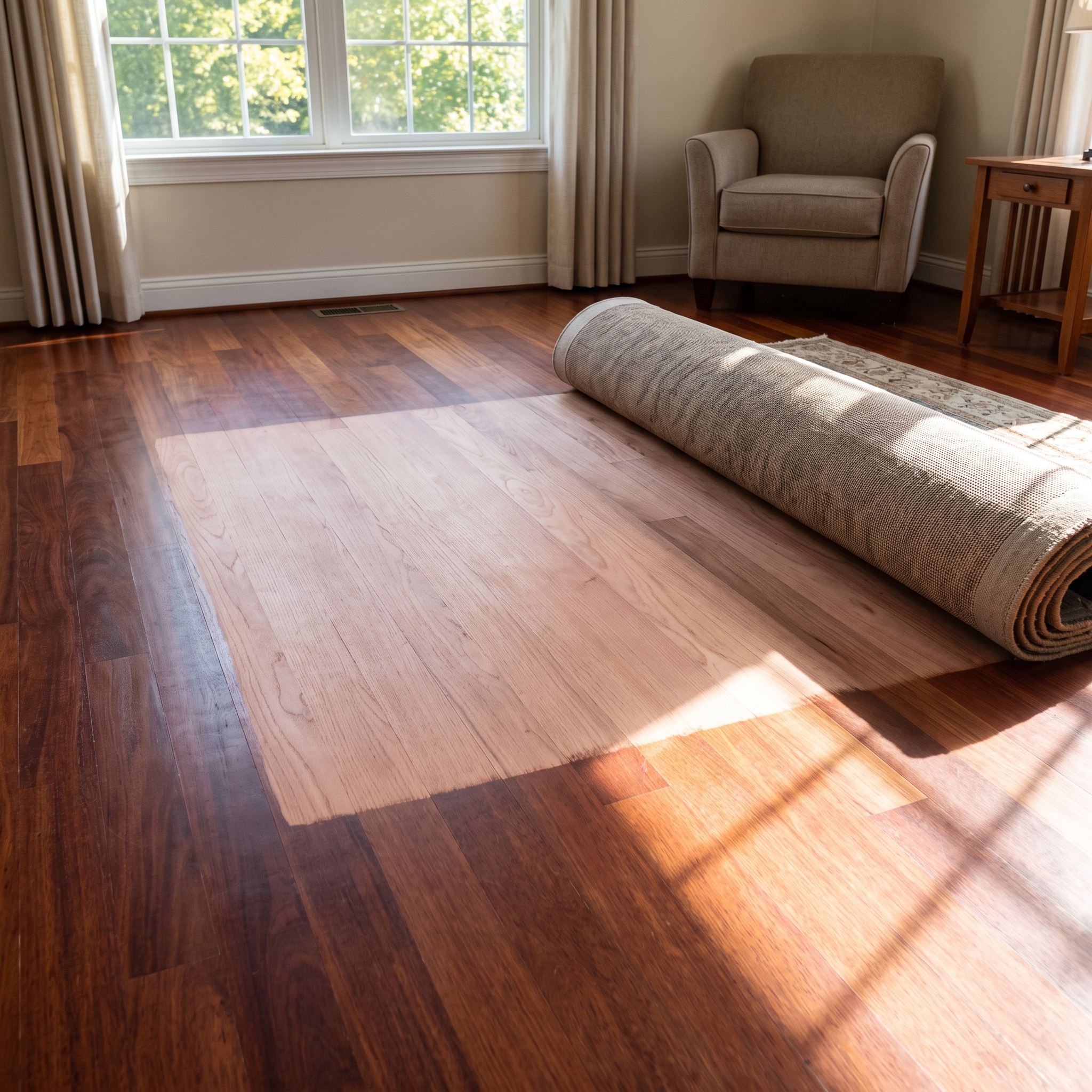
Cherry, walnut and poplar are the most light-sensitive American hardwoods. White oak, the Shore's favorite, moves slowly and evens out once the rug is lifted.
You cannot stop the change, so manage it. Rotate rugs a quarter turn every few months and shift them a foot now and then in a sunny room. Let a new floor see even light for its first season before a big rug goes down. Our article on sunlight, area rugs and hardwood floors covers the window treatments that slow the whole process.
Kitchen rugs and mats on hardwood
The best kitchen mat for hardwood floors is a washable flatwoven cotton or polypropylene runner on a thin felt-and-rubber pad. It can be lifted and dried the same day something spills on it. A waterproof kitchen mat with a solid rubber or PVC underside protects the floor from the spill and then holds the spill against the wood for a week, which is the worse of the two.
If you want a barrier under a pet bowl or in front of the sink, use a mat with a waterproof top and a breathable back, and lift it daily. Anti-fatigue gel mats are fine on hardwood as long as they have no adhesive and get lifted.
Pets, sand and grit under a rug
Sand under a rug is the most common way a rug wears a hardwood finish at the Shore, and a pad is the answer. Felt takes the grit that every footstep would otherwise grind into the finish. Vacuum the rug on both sides monthly in summer, and vacuum the floor under it, which is where the sand collects.
Pets add urine and water-bowl slop, and both wick through a rug and sit on the finish. Lift the rug and dry the floor the same day, and keep the water bowl on a mat with a breathable back. Our article on living with pets on hardwood floors covers scratches and the finishes that hide them.
A rug has already stained or marked your floor: what can and cannot be fixed
Most of what a rug does to a floor is either permanent or easy, and it helps to know which before you scrub. A yellow stain on vinyl is permanent. A sticky film on tile is easy. A dull patch on hardwood is somewhere in between.
A yellow stain on vinyl
The yellow or amber rectangle where a rubber-backed rug or mat sat on your vinyl plank is antioxidant staining. It cannot be cleaned off, because the color is inside the wear layer rather than on it. Bleach, abrasive pads and solvents dull the finish without touching the stain. The one safe thing to try is a pH-neutral vinyl cleaner, on the chance that part of the mark is surface residue from the backing, and if the color stays, the fix is replacing the planks.
Most luxury vinyl installed in the last ten years floats, meaning the planks click together and lie on the subfloor without glue, and the box or the installer will confirm which yours is. With a floating floor, an installer takes up the planks from the nearest wall to the stain and swaps the marked ones, so keep a spare box from the original job. If the floor is glued down or the line is discontinued, a room can be the practical unit of repair.
HomeAdvisor, which surveys homeowners after completed jobs, puts vinyl floor repair at $440 to $630 nationally, with most paying about $500, and vinyl plank repair at $9.50 to $12 a square foot. Bring a plank and a photo of the stain to our showroom in Belmar. Matching an existing floor from the TRUCOR and Bruce lines in our luxury vinyl catalog is often possible, and our in-house crews do the plank replacement as part of our flooring installation service.
A dull patch, sticky film or imprint on hardwood
Marks left by a rug on hardwood are usually in the finish, not the wood, and a finish can be renewed. A sticky film that sits on top of the finish, from a PVC pad that has not been down long, comes off with a hardwood cleaner and patience.
A haze that stays after cleaning is in the finish itself, whether a PVC pad softened it or a non-breathable pad trapped moisture under it, and that takes a screen-and-recoat. In a screen-and-recoat the old finish is lightly abraded and a fresh coat applied without sanding to bare wood.
National cost guides that draw on HomeAdvisor and Angi project data put screening at $1 to $2.50 a square foot and recoating at $1 to $2. A full sand-and-refinish runs $3 to $8 a square foot in the same guides. A lighter rectangle where the surrounding wood tanned and the wood under the rug did not is not damage at all. It is a difference in exposure, and it evens out with time and light.
Water that got under a rug and raised the grain, or a pad that pulled finish off a floor that had not cured, calls for a full refinish. Our hardwood and stair refinishing crews will tell you which of the two repairs a mark needs.
Sticky residue on tile or grout
A waffle pad that fused to glazed tile leaves a film that a plastic scraper, warm water and a pH-neutral tile cleaner remove, and a soft brush does the rest in the grout lines. Sealed natural stone is the exception. Test any cleaner on a hidden spot first and avoid acids, which etch stone. Once it is clean, replace the pad with natural rubber or felt-and-rubber and the problem does not come back.
Rug pads: which type for which floor
A rug pad does four jobs. It keeps the rug still, it cushions, it keeps grit and the rug's own backing off the floor, and it lets the floor breathe. No single pad does all four on every floor, so the type matters more than the brand.
Felt
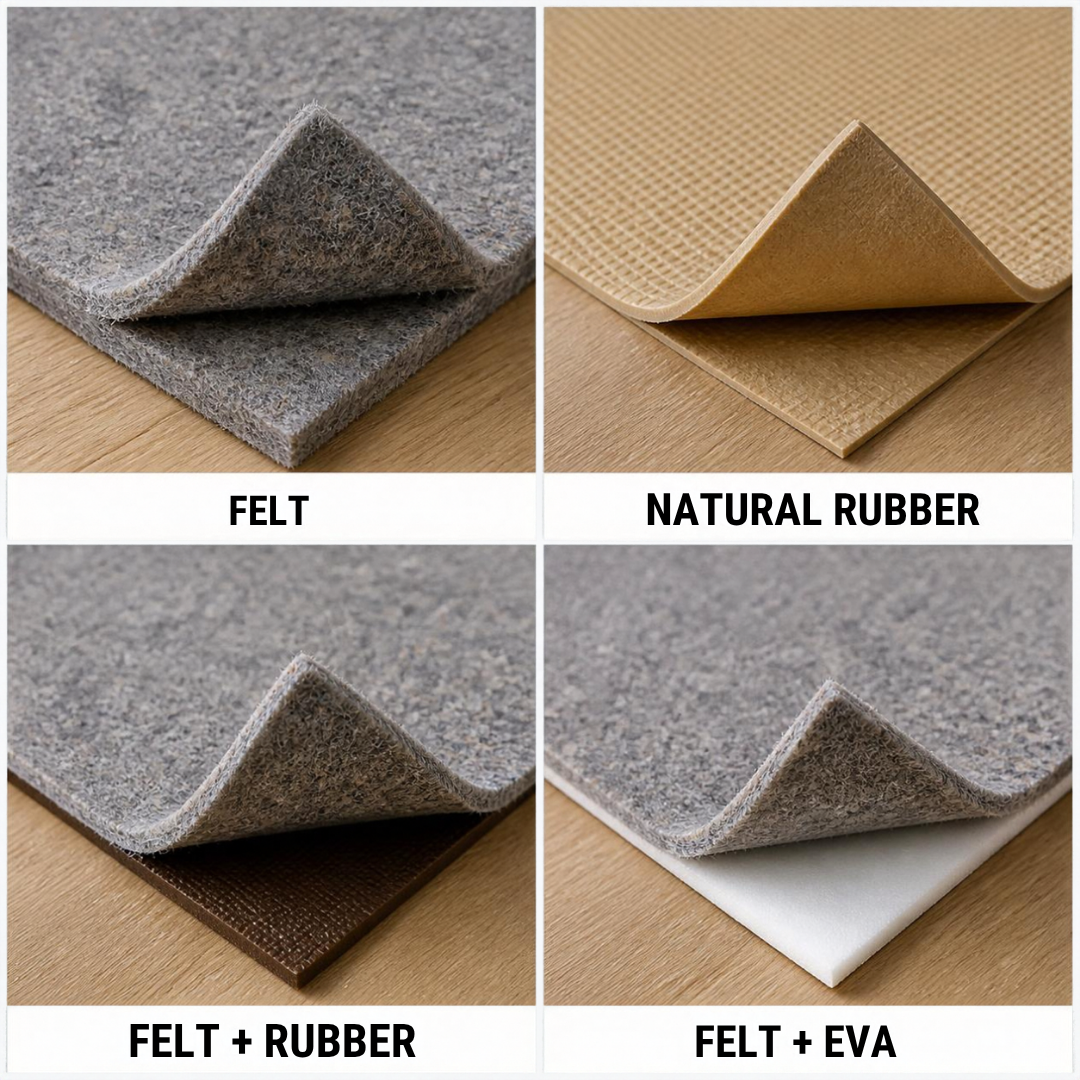
Felt pads are dense needle-punched fiber, usually recycled, in 1/8 to 1/2 inch thicknesses, and they are safe on every floor including vinyl. They cushion, insulate and breathe, and they hold a rug's backing away from the floor. They do not grip, so use felt alone only under a rug that furniture or its own weight keeps in place.
Natural rubber
Natural rubber pads are thin, usually 1/8 inch, and grip like nothing else on tile, stone and cured hardwood, with no adhesive and no residue. On vinyl they are the pad the floor makers' care guides warn against, unless the pad maker states in writing that it is non-staining on vinyl. A real natural rubber pad smells faintly of rubber, feels dense and is priced accordingly.
Felt and rubber
A felt-and-natural-rubber pad, felt on top and a thin rubber skin underneath, is the best pad for hardwood and tile and the one to buy when you are unsure. It cushions, breathes and grips. On vinyl, the same caution as natural rubber applies. On a heated floor, keep it thin.
Felt with EVA
EVA (ethylene-vinyl acetate) is the closed-cell foam of flip-flop soles and yoga mats, and it needs no plasticizer to stay flexible. Felt with a thin EVA grip layer is the pad made for vinyl plank, and it is safe there when the maker labels it non-staining or vinyl-safe. It is fine on hardwood and tile as well, though it grips less than rubber on glossy tile. TPR-backed pads, common under washable rugs, follow the same rule on every floor.
PVC waffle pads
The open-mesh PVC waffle pad is the pad to leave on the shelf for every floor on this page. Its plasticizer migrates out, it goes sticky, and it fuses to tile, grout, wood finish and vinyl alike. It is also the pad that flakes apart after a few years and leaves crumbs under the rug.
Memory foam
Memory foam pads are thick polyurethane foam, sometimes with a waterproof film, sold for cushion. They are comfortable under a bedroom rug, but they are the least breathable pad. On hardwood in a humid house they need lifting more often, on a heated floor they insulate too well, and the underside is often PVC, so check it.
Waterproof pads
A waterproof rug pad, felt with a closed-cell film that stops a spill or a pet accident from reaching the floor, does one job and carries one trade-off. Nothing gets through it in either direction, so the floor under it cannot dry. Use one under a rug in a pet's area or a kids' craft corner on vinyl or tile, where trapped moisture does no harm. Think twice on hardwood, where a wet rug is better lifted than sealed.
If you are looking for a waterproof pad that is not polypropylene, look for felt with an EVA or polyethylene film and a non-staining label. Polypropylene is a fiber, not a backing, so it was never the problem.
Thickness is the last choice, and under a door the rug plus pad has to clear the swing, so 1/8 inch is the rule in halls and entries. A 1/4 inch pad suits living rooms and bedrooms, and anything thicker under a dining table makes chairs hard to slide. Cut the pad an inch or two smaller than the rug on each side so the edges taper to the floor. A pad costs a fraction of the rug it protects.
Pad | What it is | On vinyl plank | On hardwood and tile |
|---|---|---|---|
Felt | Dense fiber, breathes | Safe; no grip | Safe; no grip |
Natural rubber | Thin grip pad | Only with a written non-staining statement | Best grip; cured floors only |
Felt and rubber | Cushion plus grip | Same caution as rubber | Best all-round pad |
Felt with EVA | Felt over a foam grip layer | The vinyl pad, labeled non-staining | Safe; less grip on gloss |
PVC waffle | Plasticized mesh | Avoid | Avoid |
Memory foam | Thick foam | Check the underside | Lift often; not over radiant heat |
Waterproof felt | Felt with a film | Safe if labeled | Traps moisture; lift often |
Choosing the rug material
Once the backing and pad suit the floor, the rug material is about how the rug lives with your household. At the Shore that means sand, wet feet, pets and renters, and each fiber handles them differently.
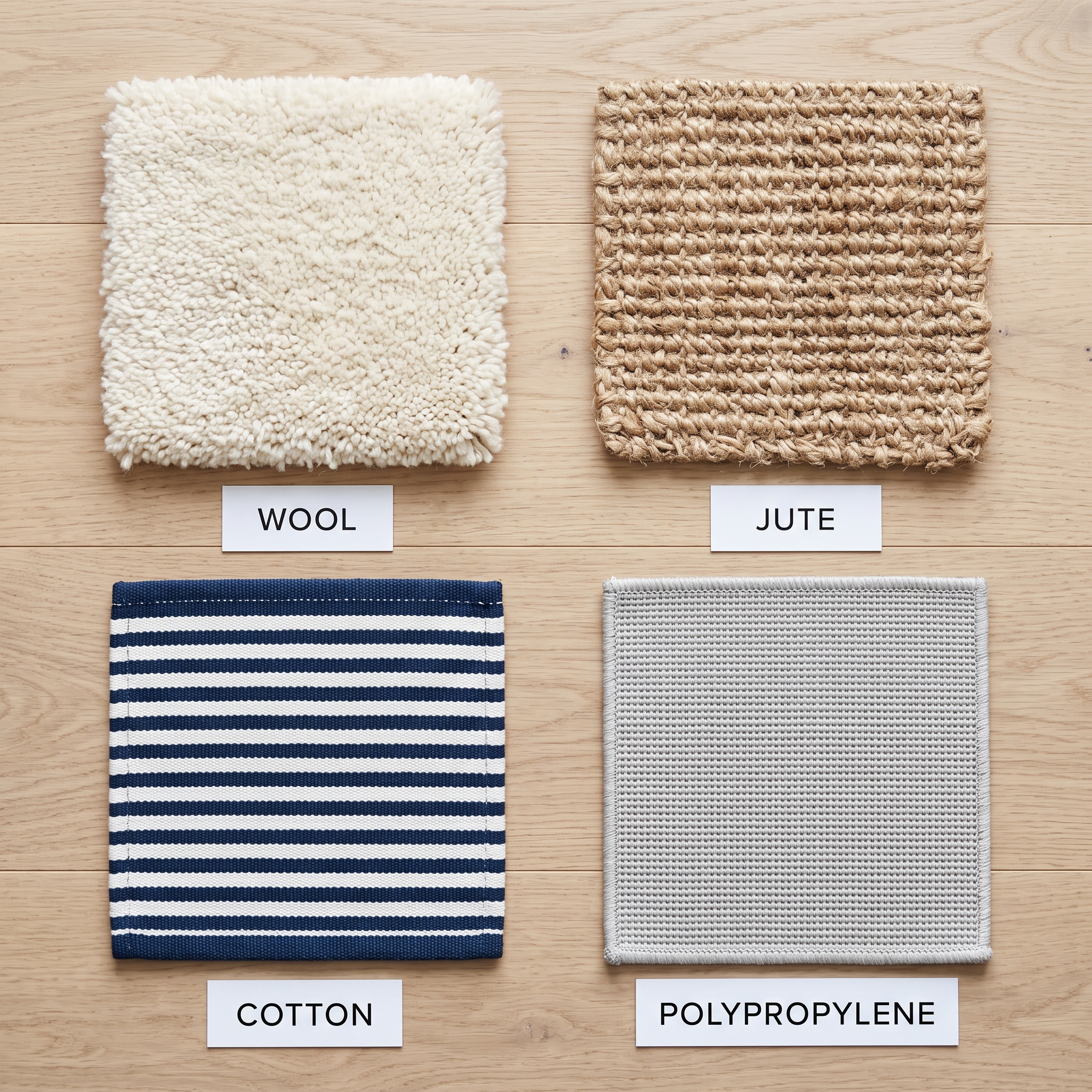
Wool is the best all-round rug fiber. It springs back after furniture, hides soil because its scales scatter light, and takes a beating for decades. It is also the most expensive per square foot, it sheds for a while when new, and in a humid house it needs airflow and regular vacuuming so absorbed moisture does not turn musty. Our comparison of wool and synthetic rugs for Jersey Shore living rooms weighs it against the synthetics in detail.
Polypropylene and polyester are the inexpensive, stain-resistant, colorfast synthetics in most machine-made rugs, and the right choice for a beach entry, a playroom or a rental. Polypropylene shrugs off wet feet and bleach, and polyester is softer and holds bright color. Neither hides soil as well as wool, and both crush faster under furniture. Nylon, the fiber of most wall-to-wall carpet, is tougher than either and is what our custom rugs from carpet are usually made of.
Cotton makes the washable flatweaves and rag rugs for kitchens and baths, and it is the easiest fiber to keep clean on any floor, though it wears fastest in a hallway. Jute and sisal give the coastal look and hide sand, and they cannot get wet. Jute stains with water and rots if it stays damp, so keep it out of kitchens, baths and mudrooms and give it a felt pad on hardwood. Viscose looks like silk and behaves like paper when wet, so it belongs in a bedroom rather than a Shore living room.
Indoor-outdoor rugs are polypropylene flatweaves made to be hosed off, and they are safe on any floor as long as the underside is the same woven yarn as the top rather than a rubber coating. Washable two-piece rugs are a fabric top on a separate pad, and everything about their safety is in the pad.
Fiber | Wear and stains | Cleaning | Relative cost |
|---|---|---|---|
Wool | Best resilience; hides soil | Vacuum; professional wash | High to very high |
Nylon | Toughest synthetic | Spot clean; professional wash | Medium |
Polypropylene | Stain and fade resistant; crushes | Hose or spot clean | Low |
Polyester | Soft, colorfast; crushes | Spot clean | Low |
Cotton | Wears fast; stains | Machine wash (flatweaves) | Low |
Jute, sisal | Hides sand; hates water | Dry methods only | Low to medium |
Viscose | Delicate; water marks | Professional only | Medium to high |
Price follows construction more than fiber. A machine-woven polypropylene rug costs the least, a machine-woven or tufted wool rug several times that, and a hand-knotted wool rug the most, with size multiplying all of it. What the retail market cannot always sell you is the right size and the right backing together.
Custom area rugs and stair runners made from any carpet we carry
Floors by the Shore, a family-owned flooring store in Belmar, New Jersey, makes custom area rugs and stair runners from any carpet in our showroom. Each one is cut to the size you need and finished at the edges, and we supply the rug pad too, so tell us which floor it will sit on. It is the answer when the room, the hallway or the staircase matches nothing a rug store stocks, and you know the backing for certain, because you saw the carpet before it was cut.
Standard sizes cover most rooms. In a living room or family room, the front legs of the sofa and chairs sit on the rug and six to eight inches of rug show beyond the sofa's arms. In a bedroom, the rug runs eighteen to twenty-four inches past the sides and foot of the bed. A dining rug needs to be big enough that chairs slide out without catching its edge, which usually means an 8 by 10 for a table of six and a 9 by 12 for eight.
Where standard sizes fail is the odd room. Think of a 22-foot upstairs hallway that needs a 4-foot-wide runner, a long open living and dining space, a landing or a staircase. Or a kitchen on LVP where you want a runner the exact length of the sink wall with no rubber anywhere on it. Those are the rugs we make, and because carpet comes off the roll in any length, a long runner is usually one piece with no seam.
Carpet makes a better rug than most people expect. A dense nylon loop pile or a low frieze, a carpet with a tightly twisted pile, from our carpet selection wears longer than most area rugs and hides sand. It is fabricated with a woven or non-staining backing that suits the floor, felt-and-rubber under a runner on a hardwood stair, felt or EVA under a rug on vinyl plank. Wool carpets are there for the living room, and patterned carpets for a hall that has to hide traffic.
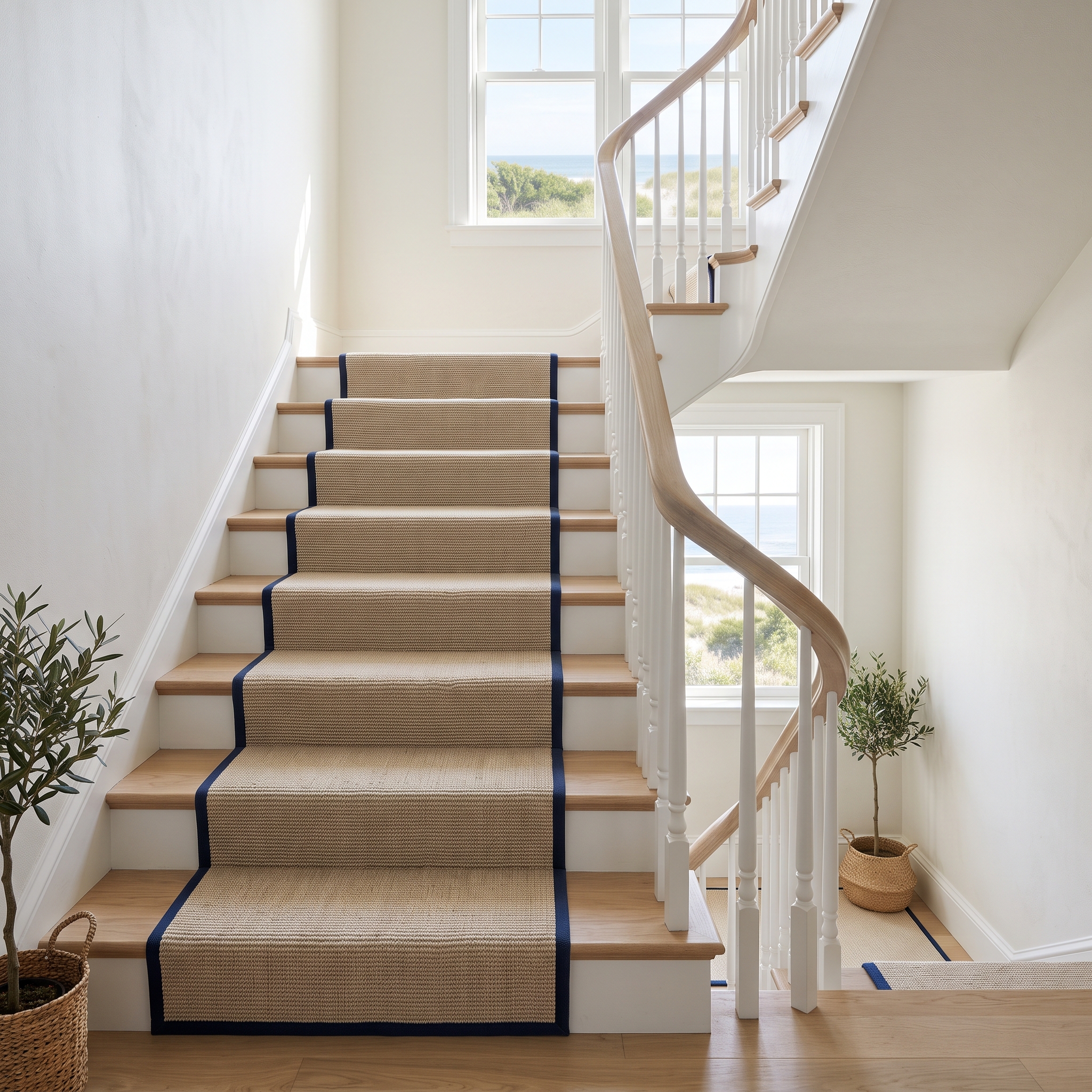
Stair runners are the most common request, because a runner has to match the tread width and the length of the flight and never move underfoot. Ours are fastened to the stairs by the same crews who handle our carpet installation, and we measure and install throughout Monmouth and Ocean Counties.
What custom fabrication costs depends on the carpet, the size, the edge finish and the pad. Edge binding is priced by the linear foot nationally, from about two dollars a foot for plain polyester binding upward for wider cotton binding or serging, a wrapped yarn edge. The carpet itself is priced by the square foot. We price each rug in the showroom once you have chosen the carpet, and you can request an estimate with the measurements of the space you want to fill.
Keeping rugs and the floor under them clean
A rug protects a floor only if the sand stays in the rug and not under it. The Carpet and Rug Institute recommends vacuuming daily in high-traffic or pet areas, twice weekly in medium-traffic areas and weekly in light-traffic areas, and a Shore family room in summer counts as high traffic.
Once a month, flip the rug and vacuum the back, then the floor under it, because a felt pad holds a surprising amount of grit. Twice a year, and after a humid stretch or a rental season, lift every rug for a day so the floor can dry.
Wet cleaning a rug in place is where hardwood gets hurt, because the water goes through the rug and pad and sits on the finish. Our list of mistakes to avoid when shampooing rugs on hardwood floors covers the ones we see most. For a rug that has taken a season of sand, dog and salt air, our area rug cleaning service starts with a dye test. Then the rug is dusted, washed by hand including the fringe, and dried fully before it comes back.
Questions people ask about rugs on hard floors
Can you put carpet over vinyl flooring?
Yes, carpet can go over an existing vinyl floor in the right conditions, and the carpet industry's installation standard, CRI 105, spells them out. Carpet over resilient flooring "may be acceptable as long as the resilient flooring is securely bonded to the substrate and all waxes, sealers, floor finishes and other foreign materials have been removed." The standard does not recommend it over floating or cushion-backed sheet goods.
That rules out carpet over a floating luxury vinyl plank floor, which is most LVP installed today. The standard also warns that some older sheet vinyl and tile may contain asbestos, which is a reason to have an installer assess the floor rather than tear it out.
Are rubber-backed rugs safe on laminate floors?
Yes for staining, because laminate's melamine wear layer has none of the plasticizer that reacts with rubber, so the yellow stain is a vinyl problem. The risk on laminate is moisture. A rubber-backed or PVC-backed mat traps water against a floor whose core swells when wet. The safe pad on laminate is the breathable felt or felt-and-rubber you would use on hardwood, lifted after any wet spell.
Pergo's care sheet asks for walk-off rugs or mats inside exterior doors and felt protectors under furniture, and some laminate makers list rubber-backed mats by name, so check yours.
What rugs work on a concrete or basement floor?
Any rug on a breathable pad works on a dry slab, and no rug works on a damp one, because concrete passes ground moisture upward and a non-breathable pad turns it into mildew. Test first. Tape an 18-inch square of plastic sheeting to the slab on all four edges, wait a day, and lift it. Darkened concrete or droplets under the plastic mean moisture is coming through, though Tnemec, a coatings maker, notes the test shows only whether moisture is present near the surface, not how much.
On a dry slab, wool or polypropylene on a felt-and-rubber pad works. On a damp one, fix the moisture before any rug goes down. A sealed, polished concrete floor, which we install and finish, is the easiest concrete to keep a rug on.
What about marble and natural stone floors?
Stone takes the same rugs and pads as tile, with two additions from the Natural Stone Institute. Use mats inside and outside the door to keep out "the sand, dirt and grit that may scratch the stone floor," and make sure the underside of any mat or rug is slip resistant. Skip adhesives and waffle pads on sealed stone, where a residue is harder to clean than on glazed tile, and lift rugs on matte or unsealed stone so moisture does not leave a shadow.
Can you put an area rug on carpet?
Yes, an area rug works on wall-to-wall carpet, but it creeps and wrinkles unless it sits on a pad made for carpet. That is a stiff, textured pad that locks into the carpet pile, not the rubber pad you would use on a hard floor. Choose a low-pile rug over a low-pile carpet, since a thick rug on a plush carpet bunches underfoot.
Do non-slip rugs really prevent falls?
Yes, a rug that cannot slide or curl is safer than one that can. The CDC's home fall-prevention checklist for older adults says of throw rugs to "remove the rugs, or use double-sided tape or a non-slip backing so the rugs won't slip." On a hard floor, the non-slip backing that also protects the floor is a natural rubber pad on tile or hardwood and an EVA-backed felt pad on vinyl.
Cut the pad smaller than the rug so the edge lies flat. A curled corner on a runner is a trip hazard whatever it is made of. That is one reason a runner made to the exact length of a hallway is safer than one that is too long.
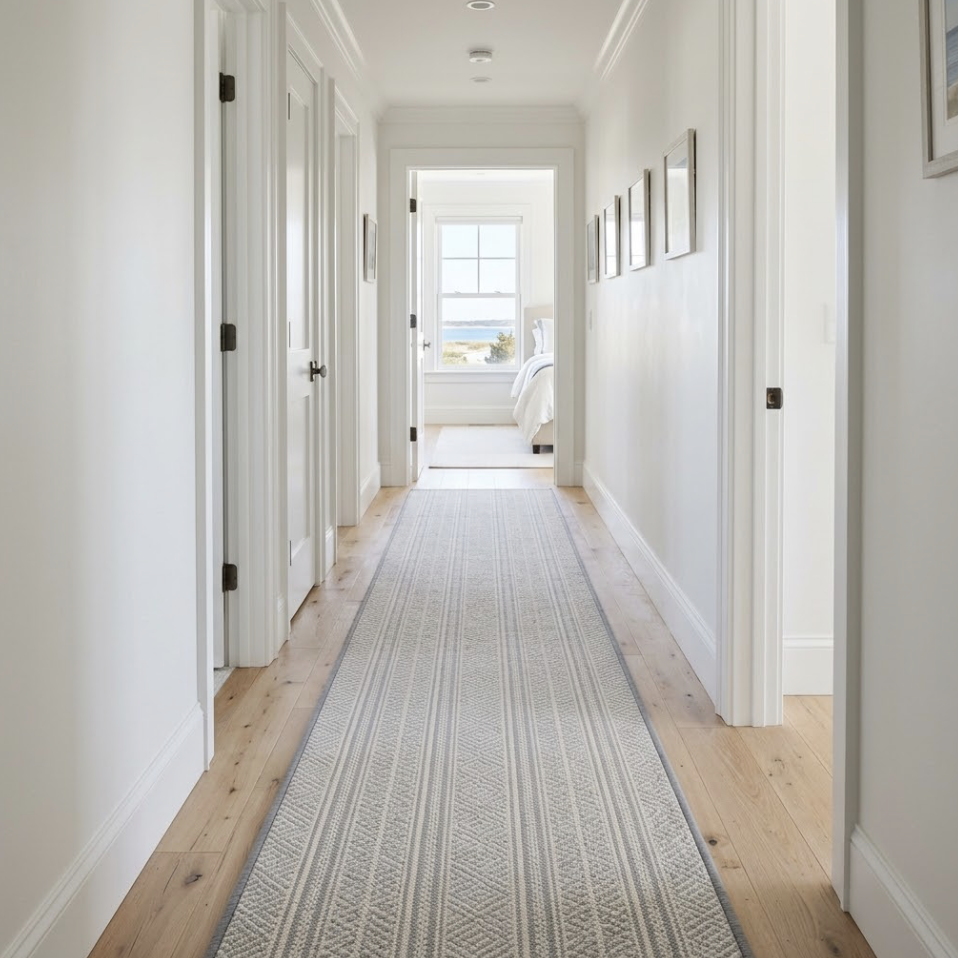
If you want a rug or runner in a size, fiber or backing the stores do not carry, or you are not sure which pad your floor needs, we can help. Bring a corner of the rug and a photo of the room to our showroom on Route 71 in Belmar. Or request an estimate, and we will come measure the space and make the rug to fit it.


