

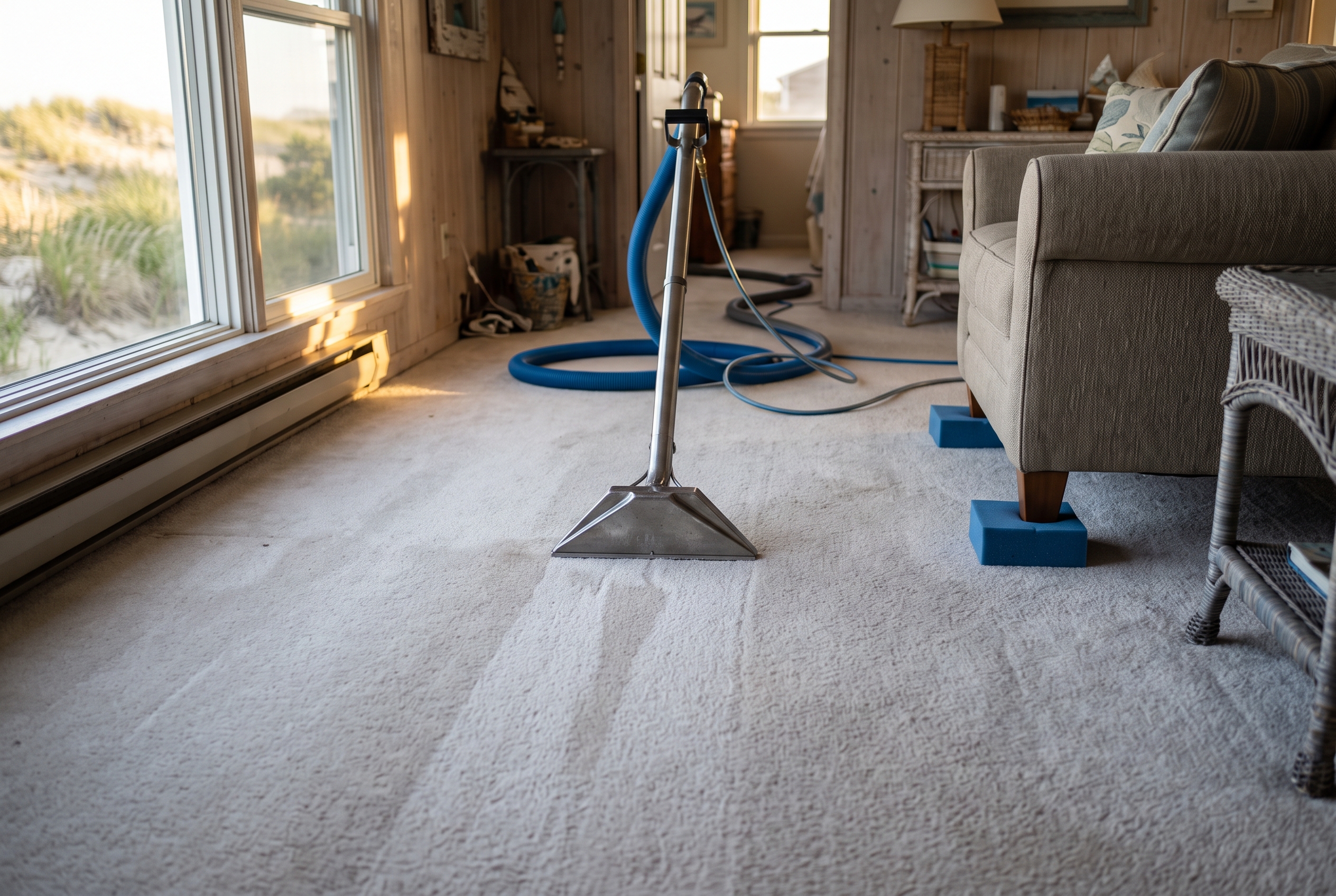
Having the carpet professionally cleaned costs about $125 to $250 for a house with three carpeted bedrooms, nationally, and the usual bill is close to $180. Priced by the square foot, that is 20 to 40 cents. Priced by the room, it is a flat $75 to $125 on the price list, with the first room carrying the trip and each room after it costing less. Stairs, pet treatment, moving furniture and a stain protector are separate lines, and they are what moves two quotes for the same house apart.
| How the job is priced | National range | A worked example |
|---|---|---|
| By the square foot | 20 to 40 cents | A 15 by 20 family room, 300 square feet: $60 to $120 |
| By the room, flat rate on the price list | $75 to $125 a room | Three bedrooms at the list rate: $225 to $375 |
| A house with three carpeted bedrooms, as paid | About $125 to $250 | The usual bill is close to $180 |
| Stairs | $3 to $5 a step | A 13-step flight: $39 to $65 |
What Carpet Cleaning Costs per Square Foot, per Room and for a Whole House
A cleaner prices a job by the square foot, by the room, or as one figure for the whole house. HomeAdvisor's cost guide for carpet cleaning, built from the project costs its customers report, puts the national rate at 20 to 40 cents a square foot and a flat room rate at $75 to $125. The same guide puts a house with three carpeted bedrooms at about $125 to $250, with the usual bill close to $180.
Those figures look like they contradict each other, since three rooms at $75 each already pass $225. They don't contradict each other, because the flat rate is what a price list says for one room, and the whole-house figure is what people paid once the added rooms were priced lower.
A per-square-foot rate is quoted on the open carpet a tape measure can reach: the rooms, usually the hall, and the landings. Stairs are always their own line. The rate moves with the carpet's condition. A carpet cleaned every year sits at the low end, and one that hasn't seen a machine in five years, or lives with a dog, sits at the top.
A per-room rate carries a size cap, often around 12 by 12 feet or about 200 square feet. A room over the cap is either two rooms or priced by the square foot after all. A room-rate quote and a square-foot quote for the same house usually land within a few dollars of each other once the extras are added. Where they differ is in how easily you can check them before the truck arrives.
Why Three Rooms Don't Cost Three Times One Room
The first room carries the drive, the setup, the hoses and the cleaner's minimum. Every room after it is priced lower. Thumbtack's carpet cleaning cost guide, drawn from the prices its cleaners charge, shows the pattern in its national averages: $130 for one room, $164 for two, $196 for three, $231 for four and $279 for five. The second room adds $34 and the fifth adds $48. The first room is the expensive one.
Many cleaners won't send a truck for less than a set amount or a set number of rooms, and a two-room minimum is common. A single bedroom therefore costs nearly what two would. Bundling every carpeted room into one visit is the discount every cleaner offers.
What counts as a room is the cleaner's rule, and the quote should say it. An L-shaped living room is often two rooms, and a big family room is sometimes two as well. Count your rooms the way the price list does before you call, so the figure you're given is for the house you have.
What a Square-Foot Price Comes to for Real Rooms
At 20 to 40 cents a square foot, a 10 by 12 bedroom comes to $24 to $48, and a whole first floor to a few hundred dollars. Measure each room's length and width in feet and multiply them. Measure the closet on its own, and count the stairs as steps.
| Room | Square feet | At 20 to 40 cents a square foot |
|---|---|---|
| A 10 by 12 bedroom | 120 | $24 to $48 |
| A 12 by 15 living room | 180 | $36 to $72 |
| A 15 by 20 family room | 300 | $60 to $120 |
| A whole first floor | 1,000 | $200 to $400 |
| A first floor plus three bedrooms | 1,500 | $300 to $600 |
The one room that breaks the arithmetic is the only room. A single bedroom at $24 to $48 lands on the cleaner's minimum instead, because the truck costs the same to send for one room as for five.
Comparing two cleaners is easier by the square foot, because the room count can't change on the day. Give both cleaners the same square footage and the same list of stairs and extras. Two room-rate quotes can only be compared once you know each cleaner's size cap and how each one counts a hall.
What a Standard Cleaning Includes, and What a Whole-House Special Leaves Out
What's included in a standard cleaning is the open carpet in the rooms on the quote: pre-sprayed, rinsed with hot water and extracted, with the light furniture slid aside and the pile groomed so it dries evenly. On most price lists everything else is a line of its own: the pre-vacuum, the stairs, the heavy pieces, spot treatment, pet treatment, a deodorizer and a protector.
A whole-house special is a fixed number of rooms with a size cap. The halls and closets are usually left out, and the stairs, the spots and the pre-vacuum are sold at the door. The price in the ad is real; it's the house in the ad that isn't yours.
The Better Business Bureau's advice on hiring a carpet cleaner is to get the estimate in writing, to make sure the quoted price covers the complete service from start to finish, and to find out up front which extras cost more. A written quote that lists every room, the stairs and each extra, with a total, is the one to compare.
There is a second kind of cleaner, and the written quote is how you tell the two apart. Under normal circumstances there should be no extra charge for moving furniture, preconditioning or routine spot and stain removal. That is the Carpet and Rug Institute (CRI), the carpet industry's trade group, in its own care guide, and plenty of good cleaners price that way: one figure for the house, with pet treatment as the only add-on.
So a quote with eight lines isn't dishonest and a quote with two isn't generous. They are the same job in two layouts, and the total is the only number to hold them to.
What Stairs, Furniture, Pets, Stains and a Protector Add to a Carpet Cleaning Quote
What adds most to the price is the stairs, the pet treatment and the heavy furniture. In a Shore house with a dog and a flight of stairs, those lines can double the bill, and the others are small. Fixr's carpet cleaning cost guide puts stairs at $3 to $5 a step and a stain protector at $5 to $10 a room; the rest of the table is national figures.
A three-bedroom quote that lands near $350 is usually the house figure plus a flight of stairs, a hall and a pet treatment, and the written quote shows which.
| Extra on the quote | National range | When it earns its line |
|---|---|---|
| Stairs | $3 to $5 a step | Every carpeted flight; never part of a room price |
| Heavy furniture moved | $10 to $50 an item | Beds, dressers and pianos; light pieces are usually free |
| Spot treatment | $25 to $40 a spot | A set stain a household cleaner has not moved |
| Pet urine treatment | $30 to $50 an hour | A spot that still smells on a humid day |
| Deodorizer | 10 to 30 cents a square foot | Rarely; it masks what the cleaning did not remove |
| Stain protector | $5 to $10 a room | An older family-room carpet; not a new one |
Water extraction after a leak is a different job, $450 to $2,000, and it comes before any cleaning.
Stairs, Hallways and Closets Are Priced on Their Own
Stairs are cleaned a step at a time with a hand tool, so they're priced a step at a time. At $3 to $5 each, a 13-step flight is $39 to $65, and a raised Shore house with two flights is about double that. A landing is a small room or two steps, whichever the price list says.
A hall is a half room or a few dollars a running foot. A walk-in closet is a small room, an extra, or skipped, and a reach-in closet is usually cleaned as part of the room it opens from. None of it is expensive, but each is a line, and a flight nobody mentioned is one of the usual reasons a quote grows on the day.
What the Crew Moves for You, and What Moving Furniture Costs
The crew slides the sofa, the chairs and the end tables as part of the price, and sets them back on foam blocks or squares of foil so the legs don't mark the damp carpet. Beds, dressers, bookcases, pianos and anything with electronics are either $10 to $50 a piece to move or left in place and cleaned around, and the quote says which. Cleaning around a dresser is fine. Under a bed is where the sand collects in a beach house, so that one is worth the fee.
Clear the small things yourself the evening before: lamps, toys, the bookcase shelves, the bed skirt lifted, cords off the floor. The prep before the cleaner arrives is an hour's work, and it keeps the crew's time on the carpet.
Pet Urine Treatment Is Priced by the Hour, and the Pad Decides Whether It Works
Pet urine treatment is priced by the hour, $30 to $50, because the work takes time. The technician finds every spot with an ultraviolet lamp, floods each one with an enzyme or oxidizing treatment, lets it work and extracts it. A family room with an old dog can take the better part of an hour on its own.
The spot that costs you the most is the one that smells again on the first humid day after the cleaning. That smell is urine in the pad or the subfloor, and a cleaning that works from the top can't reach it.
The fix for a soaked pad is a small carpet repair. The carpet is lifted at the corner, the wet section of pad is cut out and replaced, the subfloor is cleaned and sealed, and the carpet is treated and laid back down. Nationally that runs $40 to $300 a spot, with the pad material on top. Where the spots are many, that money goes further toward new carpet and a new pad over a sealed subfloor.
Heat sets urine, so a steam machine run over an untreated spot locks the stain and the smell in, and a rental machine flooded over it pushes the urine deeper into the pad. Those are the mistakes that set pet odors for good, and both happen before any cleaner is called.
Whether a Spot Treatment, a Deodorizer or a Stain Protector Earns Its Line
Spot treatment earns its $25 to $40 when the stain is set, when a household cleaner has already failed on it, or when it's blood, wine, coffee or anything a pet left. A fresh spill doesn't need a line on the quote. The spot method for fresh spills is a white towel, cool water and blotting from the edge in, and it takes ten minutes.
Skip the deodorizer unless the source of the smell is gone. It's usually a scent applied by the square foot. A carpet that still smells after a proper extraction smells because of something the extraction didn't reach, and a pet treatment or a dry-out answers that.
A stain protector is worth $5 to $10 a room on a carpet that is a few years old and lives with children or a dog. The protector it came with from the mill wears away with foot traffic and cleanings. It isn't worth paying for on a carpet in its first year. A sanitizer is for a sick room or a flood, and a routine visit doesn't need one.
What Each Cleaning Method Costs, and When the Cheaper One Is Enough
Hot water extraction, the method usually called steam cleaning, is the full reset. A pre-spray goes on, hot water is driven into the pile under pressure, and it's pulled straight back out with the soil. It's also the cleaning a warranty booklet asks you to have done on a schedule, and nationally it runs $100 to $310 a visit.
The low-moisture methods cost less and dry in under an hour. They're the right choice between deep cleanings, for a rental turnover, or for a lightly used carpet. They're the wrong choice for a carpet that hasn't been cleaned in years, because they clean the top of the pile and leave the rest.
| Method | National range for a visit | What it does well |
|---|---|---|
| Hot water extraction (steam cleaning) | $100 to $310 | The deep clean; what most warranties expect |
| Encapsulation | $80 to $200 | A light clean that dries in an hour; between deep cleans |
| Dry compound | $60 to $130 | No drying time; a lightly soiled room |
| Bonnet | $25 to $85 | A surface buff; offices more than homes |
| Shampoo | $100 to $240 | A surface clean; can leave residue in the pile |
| Carbonated | $130 to $400 | A low-moisture clean that dries fast |
Within hot water extraction, the machine matters more than the name on the truck. A truck-mounted unit heats the water hotter, drives it harder and pulls it back with more vacuum than a portable unit wheeled in the door. The carpet is rinsed instead of soaped, and it dries in hours. A portable unit is the right tool on a third floor or in a condo where the hose can't reach, and the quote is usually lower for it.
Shampooing has mostly given way to extraction. A foam that isn't rinsed out stays in the pile and collects soil, and the carpet looks dingy again in weeks.
Sand is the difference for a Shore carpet. A low-moisture pass leaves most of it in the backing, so a beach house gets hot water extraction and low-moisture cleaning in turn: the deep clean once a year and the quick method in between.
How Fiber and Carpet Type Change the Price
Synthetic carpet, which is nylon, polyester or olefin, is the base price, $60 to $300 for a job nationally. Wool runs $100 to $400 for the same rooms. The difference is the chemistry and the clock. Wool is damaged by bleach and by alkaline cleaners, so it's cleaned with a near-neutral solution, between pH 5 and 8. It takes less heat and less agitation, and it has to dry quickly or it yellows.
On wool, then, the method is hot water extraction run cooler with a wool-safe solution, or a dry compound, and the technician brings a different solution, cooler water and more time. The wool we sell, from Wools of New Zealand, cleans up well when it's treated that way. The browning that follows a supermarket shampoo and a slow dry is hard to reverse.
Berber and other loop pile carpets sit at the low end, $80 to $200, because the loops hold the soil near the surface where the wand can reach it. A loop pile also hides the vacuum marks a plush shows. A dense cut pile takes longer to dry than a loop, and a plush longer still.
Sisal, seagrass and jute are never hot-water cleaned at all. They stain and shrink with water, so they are dry-compound work or a plant job, and they're priced on their own.
How Sand, Humidity, Renters and the Closed Winter House Move the Price at the Shore
Sand is what moves a Shore quote first. It's abrasive grit that drops through the pile to the backing, where a vacuum doesn't reach it and a quick low-moisture pass leaves it. So a beach-block house is quoted as heavily soiled more often than a house a few miles inland, and it earns the pre-vacuum line an inland house can skip.
A carpet full of sand also wears faster between cleanings, because every footstep grinds the grit against the fibers. The cleaning that removes the grit is the one that buys the carpet time.
Humidity sets the drying time, and the drying time sets the season. A hot water extraction that dries in six hours in April takes a day in August with the windows open to wet air. A summer cleaning needs the air conditioning or a dehumidifier running from the moment the truck leaves. Spring and fall are the cheaper seasons to book: the carpet dries on its own, and the calendar is easier than the turnover weeks in May and September.
A rental has two cleanings in it a year. One hot water extraction goes in before the season, and a low-moisture clean, encapsulation on most price lists, fits the turnover when there is a day between tenants, since the quick job dries in an hour and the deep one doesn't. The per-room minimum works against a small unit. A one-bedroom apartment pays nearly a two-room price, and the only way to lower it is every carpeted room in one visit.
A house closed for the winter is cleaned when it's opened in spring, never the week before it's shut. A carpet that goes into a closed, unheated house with any moisture in it is the carpet that smells of mildew in May. A seasonal house that sits closed wants the thermostat left on low and the carpet bone dry before the door locks.
New Jersey adds sales tax to the bill. The New Jersey Division of Taxation's sales tax questions page says charges for carpet cleaning services are taxable, at the state's 6.625 percent, so a $200 cleaning carries about $13 of tax. A quote that doesn't show it isn't the total.
Is Professional Carpet Cleaning Worth It Against Renting a Machine?
What decides it is the state of the carpet. One room, or a carpet between professional cleanings: rent the machine. A year or more overdue, a dog, wool, or a warranty that wants a receipt: hire the professional.
The arithmetic is closer than it looks. Bob Vila's carpet cleaning cost guide puts a rental at $30 to $95 a day, plus $5 to $15 a bottle of solution. A day's rental and two bottles is $40 to $125 of your own money and most of a Saturday. The same three rooms done by somebody else in two or three hours is about $125 to $250.
The extra money buys heat, pressure and vacuum. A truck-mounted machine heats the water hotter, drives it deeper and pulls far more of it back out than a rental extractor. The two rental failures are too much water, which is where a musty smell starts, and too much soap, which stays in the pile and brings the dirt back within a month.
A rental is still a fine tool for the living room every spring and for the spill on Saturday night. Run it with the solution the machine's maker sells, make as few passes as the carpet needs, and put a fan on the floor afterward.
A cleaning does not add years to a carpet by itself. It takes out the grit, and a carpet left heavily soiled is harder to clean and wears out sooner. If someone in the house has allergies, the yearly extraction is the one that pulls the dust out of the pile instead of stirring it.
When Cleaning Stops Paying and New Carpet Is the Better Spend
Cleaning is the cheaper answer for as long as the carpet is dirty rather than worn. A professional cleaning is 20 to 40 cents a square foot. New carpet installed is about $3 to $11 a square foot in HomeAdvisor's figures. So 1,000 square feet costs $200 to $400 to clean and $3,000 to $11,000 to replace, and ten yearly cleanings, $2,000 to $4,000, still come in under one replacement.
| Option | Per square foot | For 1,000 square feet |
|---|---|---|
| One professional cleaning | 20 to 40 cents | $200 to $400 |
| Ten yearly cleanings | $2 to $4 | $2,000 to $4,000 |
| New carpet, installed | $3 to $11 | $3,000 to $11,000 |
The money stops working when a cleaning can't bring back what you're paying to bring back. Traffic lanes where the pile has been cut down and lies flat after grooming are worn rather than dirty. Matting that a vacuum and a groom don't lift is worn. So is a backing that has let go, so the carpet ripples again a month after a re-stretch, and so are urine through the pad in several places and a stain that rises again out of the pad after every cleaning.
The signs the carpet can still be saved are the opposite of each: pile that stands up, a dry pad, a smell that leaves with the moisture.
Before a house is listed, clean a sound carpet and replace a worn one. Buyers walk the traffic lanes and see wear. They don't see the dirt a cleaning removes, so a cleaning on a carpet with flat lanes buys nothing, and new carpet in the two rooms they'll stand in buys the showing. The floor check before a house is listed starts with the lanes.
Is It Worth Cleaning a 10-Year-Old Carpet?
Yes, when the pile still stands up in the traffic lanes and the pad is dry. A 10-year-old carpet in that state is dirty, and a hot water extraction brings most of its color and its spring back for a small fraction of what new carpet costs.
No, when the lanes are flat or bare, the seams or the edges have lifted, the backing shows through at the doorways, or the smell survives a cleaning and a dry-out. The cleaning money is better spent on the replacement. A 20-year-old carpet that has been cleaned on schedule can still clean up. One that has never been cleaned usually can't, because twenty years of sand has cut the fiber down.
The test is two fingers run against the pile in the hall lane. Pile that springs back is dirty, and pile that stays down is worn. The second test is a sniff on a humid afternoon with the house shut. A smell that comes up with the humidity is in the pad, and no cleaning done from the top will take it out.
What a Good Cleaning Visit Looks Like, and How Long the Carpet Takes to Dry
A visit by a trained technician has the same shape in every house, because the trade has a written standard for it. The Institute of Inspection, Cleaning and Restoration Certification (IICRC) publishes the S100 standard for professional carpet cleaning, and a certified technician works to it. Plan on about half an hour a room, and two to three hours for a three-bedroom house with stairs.
- A walk-through to find the stains, the pet spots and the worn lanes, and to agree the price.
- A dry vacuum to lift the loose soil and sand before any water touches the carpet.
- A pre-spray that sits on the pile for several minutes to loosen the oily soil.
- Agitation with a brush or a groomer to work the pre-spray through the pile.
- A hot water rinse and extraction, pass by pass, with as little water left behind as the machine allows.
- A groom to stand the pile up so it dries evenly, and fans on the floor if the day is humid.
A cut-rate visit cuts from the same list. No vacuum first, so the soil turns to mud under the wand. No dwell time for the pre-spray. A portable machine where a truck mount would fit. No clear-water rinse, so the detergent stays in the pile. The carpet looks clean the same evening and dingy in a month.
Hot water extraction leaves the carpet damp for about 6 to 12 hours, and up to a day in a humid Shore house. The carpet should be dry within 12 hours, and fans or the air conditioning get it there. The low-moisture methods are dry in about an hour. Walk on it in clean socks after a few hours, and keep shoes off until it's dry to the touch, because damp pile picks up soil from a sole.
Furniture goes back when the carpet is dry to the touch and the pad under it has had the same time. Until then the blocks or the foil stay under every wood and metal leg, because a wood stain or a rust ring from a leg set down on damp carpet does not come out.
To dry it faster, lay a box fan across the floor, run the air conditioning or a dehumidifier, open the windows only if the day is dry, and vacuum once more when it's dry to lift the pile. In August the air conditioning does the drying, and an open window brings in air wetter than the carpet.
Why Stains Come Back, Why the Carpet Smells, and What a Ripple After Cleaning Means
A spot that comes back a day or two after the cleaning is wicking. The spill or the soil sitting in the backing or the pad rises up the fibers as the carpet dries, and the clean pile carries it to the surface. It isn't new dirt and it isn't the cleaner's fault.
The fix is a dry re-treatment of the spot with an absorbent pad weighted over it overnight, which pulls the stain up and out. A cleaner who stands behind the work comes back and does that at no charge, and a written promise to redo unsatisfactory work belongs on the quote.
A musty smell is a carpet that stayed wet too long. The Environmental Protection Agency's guide to mold and moisture puts the window at 24 to 48 hours. Materials dried inside it in most cases don't grow mold, and carpet that does grow it may have to be thrown away.
So a carpet still damp the next morning gets fans and the air conditioning that day, a hand pressed into the corner to check the pad, and a lifted corner if the pad is wet. Over-wetting is also what separates a backing from its carpet, opens seams and shrinks the carpet off its tack strip. A smell that is still there after two dry days is mold in a carpet that stayed wet, and at that point the pad comes out and the carpet is judged piece by piece.
A ripple that appears after a cleaning is the carpet relaxing with the moisture where the stretch had already eased. It means the carpet needed a power stretch before the cleaner ever arrived. The fix is a re-stretch, about $100 to $300 nationally, and it's a repair, not a replacement. A carpet that ripples back a month later is the one whose backing has let go.
A carpet that is wet from a leak is a different job again. The water extraction comes first, and a carpet after a leak is saved by what happens in the first two days.
The signs that say stop are urine through the pad in several places, a backing that crumbles or sheds a sandy powder, a seam that opens again after it's sealed, and a smell that survives a dry-out. Each is money better put toward new carpet.
What a Carpet Maker's Warranty Expects From Cleaning
Most carpet warranties expect a professional hot water extraction on a schedule, and most ask you to keep the receipt. CRI recommends a restorative cleaning every 12 to 18 months, by the method the carpet's maker names. A vacuum certified under its Seal of Approval program, which tests vacuums, extractors and cleaning solutions for how much soil they remove, is a condition of many carpet warranties too.
Shaw, one of the brands we carry, asks on its carpet care page for a professional hot water extraction every 6 to 18 months, depending on traffic. Godfrey Hirst's care guide asks for the same hot water extraction, by a professional cleaner, and warns off shampooing, do-it-yourself steam cleaning and dry cleaning for its carpets. So the care page for the carpet you own, and no method table, is what the cleaner follows.
A claim is judged against the booklet that came with the carpet, and the proof it asks for is a dated invoice that names the method. A weekend with a rental machine is not that cleaning. The receipt names the company and the method, and the schedule in the booklet is the longest you can go; a Shore house with a dog and a season of sand is on the short end of it.
One house visit a year is the price of keeping the warranty whole, and a cleaning schedule for a busy Shore house runs shorter than the booklet's floor. Keep the receipt with the booklet.
Area Rugs Are Priced Differently, and We Clean Them
An area rug is priced by the square foot, at $1 to $8 nationally against 20 to 40 cents for the carpet it lies on, because the rug leaves the house. It is tested for dye bleed, dusted, washed through instead of surface-extracted, and dried flat before it comes back, with the fringe washed by hand.
An 8-by-10 rug, 80 square feet, is $80 to $640 on that range. Where a rug lands inside it follows the fiber, the dyes and the fringe: a machine-made synthetic rug near the bottom, a hand-knotted wool rug near the top.
We clean area rugs for homes throughout Monmouth and Ocean Counties, with both a hot water extraction method and a dry extraction system. Every rug that comes to our area rug cleaning starts with a dye test, so the wash can't move its colors. Then it's dusted to shake out the dry soil, washed by hand along with the fringe, dried completely, dusted a second time and trimmed of stray fibers before it comes back to you.
A rug that goes back down on a hardwood floor goes down over a pad, and the rubber-backed rug pad we sell keeps it from creeping and gives it some cushion.
Where We Come In When Cleaning Is Not the Answer
At Floors by the Shore in Belmar, we sell and install carpet and we clean area rugs. When the carpet is past cleaning, the replacement comes from our Belmar showroom: carpet from Shaw, Godfrey Hirst, Masland, Milliken and Stanton, wool from Wools of New Zealand, and natural fibers in sisal, coir, wool and organic cotton for the rooms where a natural fiber belongs.
We install carpet to the Carpet and Rug Institute's standard, as certified residential and commercial carpet installers. That means the carpet is power stretched instead of kicked in and every seam is sealed, and we stand behind every carpet we install. A carpet that ripples or opens at a seam years later is repair work we do.
The free estimate is where the carpet gets measured and priced with its pad, room by room and stairs by the step, so the number you take home is for your house. The Bissey family has been behind the counter here for over 40 years.
Questions People Ask About Carpet Cleaning Prices
Do You Tip Carpet Cleaners?
No tip is expected when carpet cleaners finish a job. A crew is paid by the job, and what a good crew wants from you is a review and the next booking. If a technician moved a piano and treated six pet spots on a hot day, a cold drink and a tip are a kindness, and nobody will refuse either.
How Long Does It Take to Clean a Three-Bedroom House?
Cleaning a three-bedroom house takes about 2 to 3 hours, with the stairs. A single room takes about half an hour. Most of that time is the pre-spray's dwell and the extraction passes, so a crew that is in and out of three bedrooms in forty minutes skipped one or the other.
Do I Need to Vacuum Before the Cleaners Come?
Yes. It's the one piece of prep that lowers the bill where a pre-vacuum is a line on the quote. A slow pass with your own vacuum lifts the loose sand and hair that would otherwise turn to mud under the wand. The technician's dry vacuum then has only the deep soil to lift.
Why Does Carpet Get Dirty Faster After a Cleaning?
Because detergent was left in the pile. A solution mixed stronger than its label, or a shampoo that was never rinsed out, dries sticky and holds every grain of sand that crosses it. The carpet looks worse within a month. The fix is a clear-water rinse and extraction, and a cleaner who does the job properly rinses every time.
Does Professional Cleaning Shorten a Carpet's Life?
No. Grit shortens a carpet's life, and a hot water extraction removes grit. What shortens it is cleaning done badly: a carpet left wet for days, a bleach-based spotter on wool, or a rental machine run over a seam that was already loose.
Why Is a Condo or Apartment Quoted Differently From a House?
Because the rooms are smaller and the truck is farther away. Apartment rooms often run $30 to $80 each instead of $75 to $125. A cleaner may add for a high floor, a long hose run from the truck, or a parking garage that keeps the truck mount outside. In that case a portable machine comes up in the elevator, and the price and the result both change.
Measuring for New Carpet When Cleaning Won't Bring It Back
Cleaning is the cheaper answer for as long as the pile stands up and the pad is dry. When the lanes are flat or the smell survives the dry-out, the money belongs in new carpet, and that starts with a free estimate at your house, where we measure the rooms and the stairs and price the carpet with its pad.


